Choosing the Right Ballet Classes: Tips for Beginners and Parents
Discover how to choose the right ballet classes with practical tips for beginners and parents, including age, instructor qualifications, safety, costs, and progress.
Table of Contents
Understanding Ballet Classes and Their Benefits
Ballet is much more than graceful movements, beautiful costumes, and performances on a stage. It is a structured form of dance that combines physical training, musical awareness, coordination, discipline, and artistic expression. For beginners, ballet classes provide an opportunity to learn fundamental movements step by step, while experienced dancers can develop greater control, flexibility, balance, and technique. For parents, enrolling a child in ballet can be a way to introduce physical activity in an environment that encourages creativity, confidence, and perseverance. However, not every ballet class offers the same experience, so choosing the right one requires careful consideration of the student’s age, interests, abilities, and goals.
When exploring ballet classes, start by understanding what you want to achieve. Perhaps your child enjoys dancing at home and wants to learn proper technique, or maybe you are an adult who has always wanted to try ballet. You might also be looking for a structured activity that helps your child develop coordination and social skills. Each situation calls for a slightly different class format and teaching approach. Some studios focus on recreational dance and enjoyment, while others offer more intensive training for students interested in examinations, competitions, or professional performance. The best choice is not necessarily the most prestigious studio; it is the one that provides appropriate instruction, a welcoming atmosphere, and a positive learning experience.
Physical, Mental, and Emotional Benefits of Ballet
One reason ballet attracts students of different ages is that it develops several skills simultaneously. During class, dancers practise posture, balance, controlled movements, and coordination while responding to music and following instructions. Regular participation can contribute to strength, mobility, body awareness, and physical fitness, depending on the intensity and frequency of training. Ballet also challenges students to remember sequences, recognise rhythms, and coordinate different parts of the body. These activities make each lesson a combination of physical exercise and mental engagement rather than simply repeating dance movements.
Ballet can also help students build patience and confidence. A movement that feels difficult during the first lesson may become more comfortable after several weeks of guided practice. This gradual improvement teaches an important lesson: progress often comes from consistency rather than immediate perfection. Children may learn to listen carefully, take turns, cooperate with classmates, and manage nervousness when performing in front of others. Adults can benefit from having a creative activity that offers a break from everyday routines. However, the benefits depend on the student’s experience, the quality of instruction, and whether the classes remain enjoyable and appropriately challenging.
Choosing Ballet Classes Based on Age and Experience
Age and experience are two important factors when selecting ballet classes, but they should not be the only things that determine placement. A good dance school considers a student’s physical development, coordination, confidence, previous training, and ability to follow instructions. A young child who has never attended a dance lesson may benefit from a playful introductory class, while a teenager with several years of experience may need more structured technical training. Similarly, an adult beginner should not feel pressured to join an advanced class simply because they are physically fit or familiar with other forms of exercise. Before enrolling, ask how the school groups students and whether the teacher can recommend an appropriate starting level.
The ideal class should provide enough challenge to encourage improvement without making students feel overwhelmed. Beginners generally need time to learn basic positions, posture, footwork, and musical timing before attempting complex combinations. Students who already have experience may benefit from an assessment lesson to identify their strengths and areas for improvement. Remember that moving slowly through the fundamentals is not a disadvantage; it creates a stronger foundation for future progress. When comparing ballet classes, look for a school that respects individual learning speeds rather than treating every student as though they should develop at exactly the same rate.
Ballet Classes for Young Children
For young children, ballet is often an introduction to movement, rhythm, imagination, and following simple instructions. Classes designed for preschoolers commonly use short activities, musical games, storytelling, and gentle movement exercises to keep children engaged. Instead of expecting a four-year-old to perform technically demanding movements, a suitable instructor may encourage the child to balance like a flamingo or move gracefully like a butterfly. These playful activities introduce coordination and body awareness while allowing children to enjoy the experience. Parents should ask about the school’s recommended starting age because age policies, lesson structures, and teaching approaches vary between studios.
When choosing ballet classes for children, pay close attention to the emotional atmosphere. A child should feel comfortable asking questions, making mistakes, and learning alongside other students. The teacher should give age-appropriate instructions, use positive feedback, and avoid pressuring children to stretch beyond their natural range of movement. It is also helpful to ask whether parents can observe a trial lesson, how the school handles separation anxiety, and what happens if a child needs a break. Ultimately, the right class is one in which your child feels safe, enjoys participating, and gradually develops new skills.
Ballet Classes for Teenagers and Adults
Teenagers may approach ballet with different goals. Some want to develop a new hobby, others want to improve their dance technique, and some may be interested in auditions or professional training. Before selecting a class, determine whether the student needs recreational lessons, beginner technique, intermediate training, or a more intensive programme. A teenager with no previous ballet experience should have access to a genuine beginner class rather than being expected to keep up with experienced dancers. If the goal is advanced training, ask about progression requirements, attendance expectations, examination options, and the amount of practice needed outside class.
Adult ballet classes are also an excellent option for people who want to explore dance later in life. You do not need to have started ballet as a child to enjoy learning its fundamentals. Look for classes specifically designed for adult beginners, with teachers who understand that students may have different levels of flexibility, fitness, coordination, and mobility. A welcoming studio will explain movements clearly, offer suitable modifications, and encourage students to work within their comfortable range. Convenience matters, too: an evening or weekend class near your home or workplace may be easier to attend consistently than a school that requires a difficult journey. Your first goal should be to establish a positive routine, not to master every movement immediately.
Evaluating Ballet Schools and Dance Studios
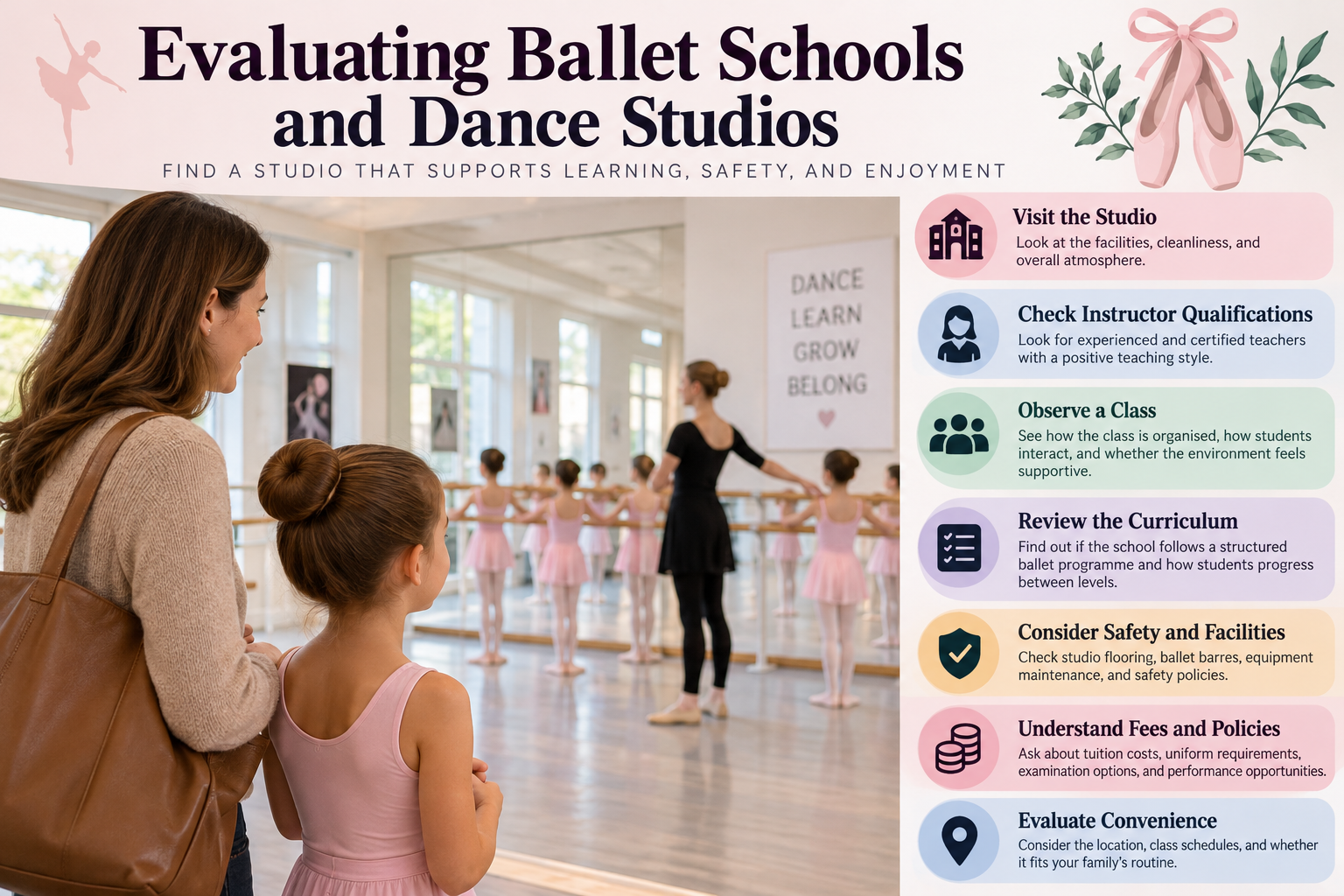
Once you understand the student’s needs, compare the available dance schools. A beautiful studio, impressive photographs, and an attractive website can make a strong first impression, but they do not necessarily demonstrate teaching quality. Visit the premises if possible and observe how classes are organised. Notice whether students have enough room to move, whether the floors appear suitable for dance, and whether equipment such as ballet barres is secure and properly maintained. Ask about class schedules, lesson duration, attendance policies, trial sessions, and the studio’s approach to student development. If the school offers several dance styles, check that its ballet programme has a clear curriculum rather than simply adding a few ballet movements to a general dance class.
A reliable studio should also communicate openly with parents and students. You should be able to obtain clear information about fees, registration requirements, uniforms, performance opportunities, and additional expenses before committing. Ask whether the school follows a recognised ballet syllabus or uses its own structured programme, and find out how students progress from one level to another. Some studios emphasise recreational dance, while others prioritise formal examinations, competitions, or professional preparation. Neither approach is automatically better; the right choice depends on the student’s ambitions and personality. Take time to compare teaching standards, safety procedures, and the school’s expectations before making a decision.
Instructor Qualifications and Teaching Style
The instructor can have a major influence on how a beginner experiences ballet. Look for someone with relevant dance-teaching qualifications, suitable experience, knowledge of age-appropriate instruction, and an understanding of safe dance practice. Professional performance experience can be valuable, but being a talented performer does not automatically mean someone can teach beginners effectively. A good teacher can explain a movement in simple language, demonstrate it clearly, recognise common mistakes, and provide constructive feedback without embarrassing students. They should also understand how to adapt exercises when a student has difficulty with a movement or needs additional support.
Teaching style matters just as much as qualifications. During a trial class, observe whether the instructor treats students respectfully and provides corrections that help them improve. Do students appear engaged, or do they seem frightened of making mistakes? Does the teacher explain why a movement should be performed a certain way? Ask prospective instructors about their training, teaching experience, and approach to beginner education. Their answers should give you confidence that students will receive structured guidance rather than being left to imitate movements without understanding the technique.
Class Size, Structure, and Learning Environment
Class size affects how much individual attention each dancer receives. In a small beginner class, the teacher may find it easier to notice posture problems, answer questions, demonstrate movements again, and provide personalised feedback. A larger class can still be effective when it is well organised and supported by suitable teaching arrangements, but beginners may have fewer opportunities for individual correction. Ask how many students usually attend each session and whether additional instructors or assistants are present when needed. For young children especially, consider whether the teacher can manage the group while ensuring that each student receives appropriate attention.
The structure of a class is equally important. A well-planned lesson typically includes a suitable warm-up, exercises that develop foundational technique, movement combinations, musical activities, and a gradual cool-down when appropriate. Students should have opportunities to practise skills repeatedly while learning how to move with control. The atmosphere should be encouraging rather than excessively competitive, and the teacher should make reasonable adjustments for students who need extra time. Check whether the studio uses suitable flooring and provides enough space for safe movement. When these elements work together, students can focus on learning instead of worrying about their surroundings.
Understanding Ballet Class Costs and Value
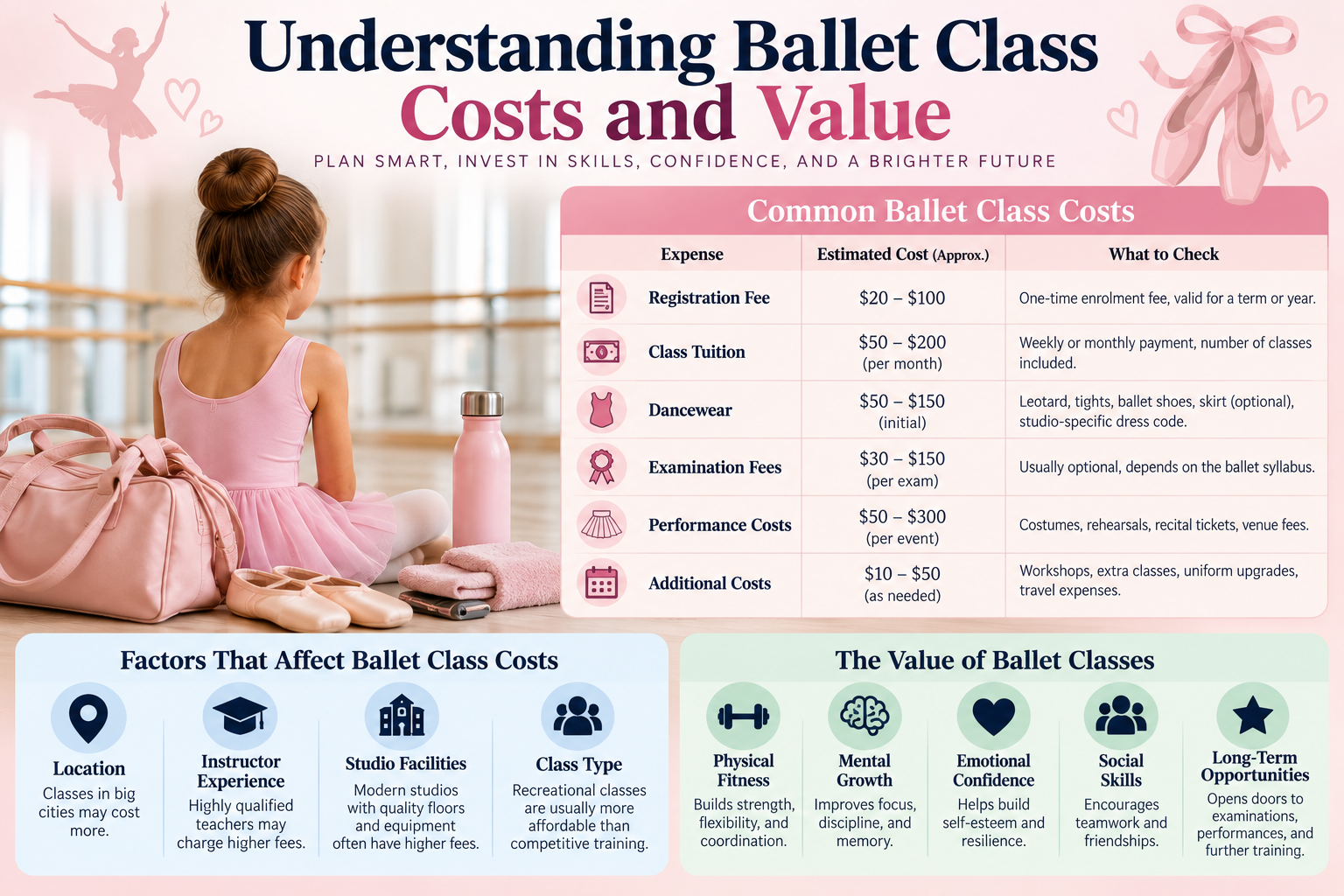
The price of ballet classes varies according to location, instructor experience, lesson duration, studio facilities, and the type of programme offered. Some schools charge monthly tuition, while others offer term-based packages, individual lessons, or discounted fees for multiple weekly classes. A low advertised price may look appealing, but it is important to understand exactly what it includes. Registration fees, uniforms, ballet shoes, examination charges, costumes, recital tickets, and performance participation may increase the overall cost. Before enrolling, request a complete fee breakdown so you can compare schools fairly and avoid unexpected expenses.
Expense | What to Check |
Registration | Is there a one-time enrolment fee? |
Tuition | Is payment weekly, monthly, or per term? |
Dancewear | Are specific leotards, tights, or shoes required? |
Examinations | Are they optional, and what are the fees? |
Performances | Are costumes, rehearsals, or tickets charged separately? |
Missed classes | Are make-up lessons or refunds available? |
Good value does not necessarily mean choosing the cheapest option. A reasonably priced class with a qualified instructor, a safe facility, clear communication, and suitable student support may provide a better experience than a more expensive programme that does not match your needs. At the same time, a high fee does not guarantee superior teaching. Compare the total cost with the quality of instruction, travel time, schedule, class size, and opportunities for progress. Parents should also consider whether the family can comfortably maintain the expense throughout the term. Ballet is a skill that develops through regular participation, so a sustainable arrangement is often more useful than an ambitious programme that becomes financially stressful after a few months.
What to Wear and Bring to Ballet Class
Appropriate clothing allows students and teachers to see body alignment and makes movement easier. Many ballet studios ask students to wear a leotard, tights, and ballet slippers, although requirements vary by age, programme, and school. Some beginner classes allow comfortable fitted exercise clothing until students decide whether to continue. Before purchasing an expensive uniform, ask the studio for its dress code and recommendations. Well-fitting ballet slippers are important because shoes that are too tight, too loose, or unsuitable for dance can make movements uncomfortable. Pointe shoes are a separate category and should never be purchased or used by beginners without appropriate professional assessment and guidance.
Students should also bring a water bottle and arrive with enough time to change and prepare. Long hair is often secured away from the face, and jewellery that could catch on clothing or cause injury should generally be removed. Keep belongings organised and avoid bringing unnecessary valuables into the changing area. Parents can help young children practise getting ready independently by packing their dance bags together and checking that all required items are included. These simple routines make the class feel more predictable and reduce last-minute stress. Most importantly, clothing should support comfortable, safe participation rather than create pressure to look a certain way. Every student deserves to feel welcome regardless of body shape, appearance, or previous dance experience.
Safety, Warm-Ups, and Injury Prevention
Safety should be a priority when selecting ballet classes, especially for children and complete beginners. Ballet requires balance, strength, coordination, and controlled movement, and these abilities develop over time. A responsible instructor introduces exercises progressively, explains correct technique, and discourages students from forcing turnout, overstretching, or copying advanced movements before they are ready. The studio should have adequate space, appropriate flooring, well-maintained equipment, and clear procedures for dealing with injuries or illness. Parents should also ask who is responsible for first aid and what safeguarding measures are in place for children.
Students should learn to distinguish normal effort from pain. Mild muscle fatigue may occur during exercise, but sharp pain, persistent discomfort, swelling, or difficulty bearing weight should never be ignored. Stop an activity that causes pain and seek appropriate medical advice when necessary. Warm-ups should prepare the body for the movements planned in class rather than forcing immediate flexibility. Students should also receive suitable rest, hydration, and recovery time between sessions. If a child has a medical condition, previous injury, or specific physical limitation, discuss relevant participation needs with an appropriate healthcare professional and the instructor. Going en pointe requires particular caution, and readiness should be assessed by a qualified instructor based on factors such as strength, technique, training history, and physical development. No student should feel pressured to attempt pointe work simply to keep up with classmates.
Setting Realistic Goals and Tracking Progress
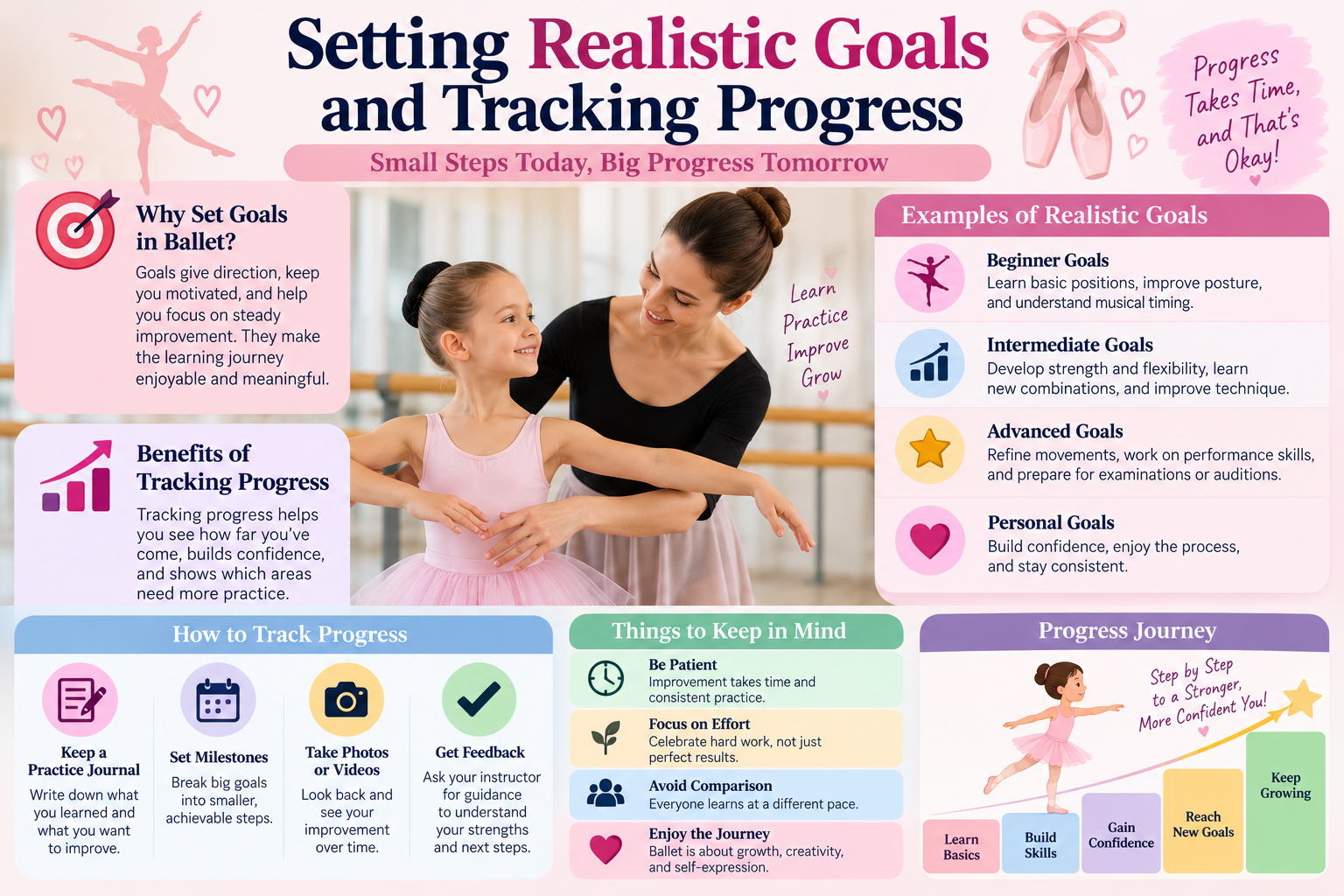
One of the most helpful things beginners can do is set realistic goals. During the first few lessons, you may focus on standing with better posture, learning basic ballet positions, understanding rhythm, and following simple combinations. These goals might seem small, but they are the building blocks of more advanced technique. Instead of expecting dramatic improvements after a single class, pay attention to gradual changes in balance, coordination, confidence, and movement control. Keeping a simple practice journal can help students recognise improvements that might otherwise go unnoticed.
Parents should also remember that every child develops at a different pace. One student may quickly remember combinations but struggle with balance, while another may have excellent coordination but need more time to feel confident in a group. Comparing children can create unnecessary pressure and reduce the enjoyment of learning. Ask the instructor how progress is assessed and whether feedback is based on individual development rather than comparisons with classmates. Examinations and performances can provide useful goals when they suit the student, but they should not be the only measures of achievement. A child who becomes more confident, enjoys attending lessons, and learns to practise patiently is making meaningful progress even without winning a competition or receiving a formal certificate.
Preparing for the First Ballet Class
Your first ballet class may feel exciting and slightly intimidating, especially if you have never taken a dance lesson before. Preparing in advance can make the experience much more comfortable. Confirm the class time, location, dress requirements, arrival instructions, and whether you need to bring anything specific. Beginners should arrive a little early so they can meet the instructor, become familiar with the studio, and ask any questions before the session begins. If you are enrolling a young child, explain what will happen in simple terms and reassure them that they are there to learn, not to perform perfectly.
During the lesson, listen carefully, follow the teacher’s demonstrations, and ask for clarification when necessary. You do not need to memorise every position or movement immediately. It is perfectly normal to lose track of a combination, feel awkward while practising a new step, or need several demonstrations before understanding an instruction. Give yourself permission to be a beginner. After class, think about what you enjoyed and what felt challenging. If a trial lesson is available, use it to evaluate the teacher’s communication, the class atmosphere, and the suitability of the exercises. A positive first experience can help you decide whether the school is a good long-term fit.
How Parents Can Support Young Ballet Dancers
Parents play an important role in helping children develop a healthy relationship with dance. The most effective support often comes from showing interest, encouraging consistent attendance, and celebrating effort rather than demanding perfect results. Ask your child what they enjoyed about class, which movement they found interesting, and what they would like to learn next. These conversations help children express their feelings without making every lesson feel like an assessment. If your child makes mistakes, remind them that learning takes time and that even experienced dancers continue practising fundamental skills.
It is also important to communicate with the instructor. Ask about attendance expectations, progress, upcoming performances, and any concerns you notice at home. If your child appears anxious, repeatedly complains about pain, or no longer wants to attend, try to understand the reason before making a decision. The issue could be ordinary nervousness, an unsuitable class level, excessive pressure, a difficult schedule, or an uncomfortable environment. Parents should also pay attention to safeguarding policies, supervision arrangements, and how the school communicates with families. A good studio welcomes reasonable questions and treats children respectfully. Most importantly, allow your child to have a voice in the experience. Ballet should be an opportunity for growth and enjoyment, not a source of constant pressure to satisfy someone else’s expectations.
Common Mistakes to Avoid When Choosing Ballet Classes
Choosing the wrong ballet class can lead to frustration, unnecessary expenses, and a loss of enthusiasm. One common mistake is selecting a school based entirely on its reputation or social media photographs. An attractive studio might not provide the right beginner programme, while a smaller school may offer excellent instruction and more personal attention. Another mistake is assuming that expensive classes are automatically better. The quality of teaching, student support, safety procedures, and curriculum matters far more than appearances alone.
Families should also avoid enrolling students in advanced classes before they have the necessary foundation. Ballet technique develops progressively, and rushing through basic skills can create poor habits that become difficult to correct. Buying expensive dancewear before confirming the dress code, overlooking additional performance fees, and ignoring travel time are other avoidable problems. Finally, do not choose a highly competitive programme simply because it appears more serious or prestigious. Some students thrive in intensive environments, while others prefer recreational lessons that focus on enjoyment and personal development. The best decision comes from matching the programme to the student’s needs, rather than choosing the option that looks most impressive.
The Ultimate Sohimi Buying Guide: Features, Value, and Shopping Tips
Why Florasis ( Hua Xizi) Is Gaining Attention in the Global Beauty Market
Why Beauty Enthusiasts Are Exploring MelodySusie for Nail Care
Key Things to Know About Sports Services From Svenska Spel – Sport
How Online Travel Platforms Like Musement Make Experience Planning Easier
Questions to Ask Before Enrolling
Before committing to a ballet school, prepare a few practical questions. These will help you compare options and understand what the student can expect.
- What qualifications and experience does the ballet instructor have?
- Is the class designed for complete beginners and the student’s age group?
- How many students typically attend each lesson?
- What safety and safeguarding policies does the school follow?
- Does the studio have suitable flooring and well-maintained equipment?
- What is included in the tuition fee, and what additional expenses should we expect?
- Are trial lessons available before registration?
- How are students assessed and moved to higher levels?
- Are examinations, competitions, or performances compulsory?
- What happens if a student misses a lesson or needs to pause their enrolment?
Pay attention not only to the answers but also to how the school responds. Clear, respectful communication is a positive sign. A school that explains its policies openly makes it easier for students and parents to understand their responsibilities. If an important issue remains unclear, ask for written information before paying fees. Taking a little extra time to investigate can help you find a programme that feels comfortable, safe, and suitable for the long term.
Conclusion
Choosing the right ballet classes is about finding the right balance between quality instruction, student safety, affordability, convenience, and enjoyment. Whether you are an adult exploring a new hobby or a parent helping a child discover dance, the best starting point is to understand your goals and compare classes that match your experience and abilities. Look for qualified instructors, age-appropriate lessons, a supportive learning environment, transparent fees, and a clear approach to progression.
Remember that ballet is a journey rather than a race. Students do not need to master every movement immediately, and children should never feel that their progress depends on competing with others. A suitable class encourages patience, builds confidence, and provides opportunities to improve through consistent practice. Take time to visit studios, ask questions, and try a beginner lesson when possible. With the right guidance and realistic expectations, ballet can become a rewarding activity that supports creativity, coordination, discipline, and a lifelong appreciation of dance.
Frequently Asked Questions
Q. What is the best age to start ballet classes?
A.The appropriate starting age depends on the child's readiness and the studio's programme. Some schools offer playful movement classes for preschoolers, while others introduce structured ballet lessons at a later age. Parents should look for age-appropriate teaching that focuses on coordination, musical awareness, and enjoyment rather than demanding advanced technique too early.
Q. Can adults start ballet classes without previous experience?
A. Yes. Adults can begin ballet without any previous dance training. Look for a dedicated adult beginner class where the instructor explains fundamental movements, offers suitable modifications, and creates a welcoming environment. Regular attendance and patient practice are more important than starting at a young age.
Q.How much do beginner ballet classes cost?
A. The cost varies according to location, studio facilities, class duration, and teaching experience. Some schools charge monthly tuition, while others use term-based fees or individual lesson rates. Ask about registration, dancewear, examination, and performance expenses before enrolling so you can estimate the total cost.
Q. What should a beginner wear to ballet class?
A. Most studios recommend fitted dancewear, such as a leotard, tights, and suitable ballet slippers. However, requirements differ between schools, and some introductory classes accept comfortable exercise clothing. Confirm the dress code with the instructor before buying specialist dancewear.
Q. How can parents tell whether a ballet class is suitable for their child?
A. Look for a qualified teacher, a safe and welcoming studio, age-appropriate activities, clear communication, and manageable class sizes. Your child should feel comfortable participating and receive constructive feedback. Enjoyment, gradual improvement, and a sense of safety are important indicators that the class is meeting your child's needs.
Table of Contents
Related Posts