
How Online Travel Platforms Like Musement Make Experience Planning Easier
Planning a trip used to mean juggling a surprising number of tabs, bookmarks, emails, maps, review sites, attraction websites, and notes on your phone. You might know which city you want to visit, but the moment you start asking what to actually do there, the planning process can become much more complicated. Which attractions are worth visiting? Which tours fit your schedule? Is a particular museum open on the day you arrive? Should you reserve a popular activity before traveling, or can you simply buy a ticket when you get there? Online travel experience platforms such as Musement are designed to make this part of travel simpler by bringing activities, tours, attractions, and other things to do into a more convenient digital planning environment. Instead of treating experiences as an afterthought, travelers can make them part of the trip from the beginning. This matters because modern travel is increasingly about participation rather than passive sightseeing. Recent industry research also shows that travelers continue to place substantial value on tours, activities and attractions, while the experience sector remains fragmented and comparatively difficult to book digitally.
Table of Contents
The Rise of Experience-First Travel
Travel has changed significantly over the past decade. A hotel and flight may get you to a destination, but they do not necessarily determine what you remember about it. Increasingly, travelers are building trips around cooking classes, walking tours, cultural performances, museums, outdoor adventures, food experiences, attraction tickets and activities that allow them to interact with the destination. Tripadvisor’s 2026 Trendcast describes experiences as increasingly influential in travel planning, while its mid-year data shows growing demand for activities that provide cultural connection, learning and participation. This shift explains why platforms focused on experiences have become useful complements to traditional hotel and flight booking websites. Instead of asking only, “Where should I stay?” travelers are asking, “What do I want to experience when I get there?” That small change in the question can completely change the planning process. It encourages people to think about their available time, interests, budget and travel companions before they arrive. An experience platform can then help turn those ideas into actual bookable activities rather than leaving travelers to search randomly across dozens of websites.
Why Travelers Want More Than Sightseeing
There is nothing wrong with visiting famous landmarks, but modern travelers often want something that feels more personal. A photograph outside a famous building may be memorable, yet taking a cooking class with a local instructor, exploring a neighborhood with a guide, attending a traditional performance, or learning about a city’s history from someone who lives there can create a deeper connection. Current Tripadvisor data illustrates this movement toward participation: craft classes were its fastest-growing experience category in the first half of 2026, with bookings rising 88% year over year, while concerts and special events increased 87%. These trends show why experience discovery is no longer simply about finding the biggest attraction. Travelers increasingly want activities that fit their personalities and interests. Online platforms make this easier because they can put very different types of experiences next to one another. A traveler interested in food can look for culinary activities, while another person may prefer history, art, adventure, family entertainment or relaxation. The result is a more flexible approach to travel where the destination becomes a collection of possibilities rather than a fixed list of tourist attractions.
What Is an Online Experience Platform?
An online experience platform is essentially a digital marketplace for things travelers can do at a destination. Instead of focusing primarily on transportation or accommodation, these services concentrate on activities such as tours, attractions, museum visits, sightseeing experiences, classes, excursions and other bookable experiences. The concept sounds straightforward, but the value comes from bringing fragmented information together. Experience providers are often small or local businesses, and industry research indicates that more than 70% of experience operators are small or micro-businesses. That makes the market much more fragmented than the airline or hotel industry. A traveler searching independently might therefore need to discover many different providers, visit separate websites, compare availability, understand cancellation policies and complete several unrelated checkout processes. A marketplace can act as a bridge between these individual suppliers and travelers. Platforms such as Musement can make the process feel more like shopping for travel experiences in one place. This does not eliminate the need for research, but it can reduce the amount of searching and coordination required before a trip.
How Platforms Connect Travelers With Experiences
The basic idea is similar to having a digital directory that is organized around what travelers actually want to do. A user can start with a destination and then explore available experiences instead of searching for individual operators one by one. The platform handles much of the information presentation, allowing travelers to evaluate options based on factors such as activity type, date, duration, reviews and availability. This structure is particularly helpful in destinations where the number of possible activities can feel overwhelming. Imagine arriving in Rome with only three free days. You could independently research the Colosseum, Vatican Museums, food tours, walking tours, day trips and other attractions, or you could start with a centralized experience marketplace and narrow the options according to your interests. The difference is not necessarily that one approach discovers better experiences; it is that the organized platform can make the discovery process more manageable. In a world where travelers already face an enormous amount of online information, reducing the number of decisions they have to make can be valuable in itself.
How Musement Simplifies Experience Discovery
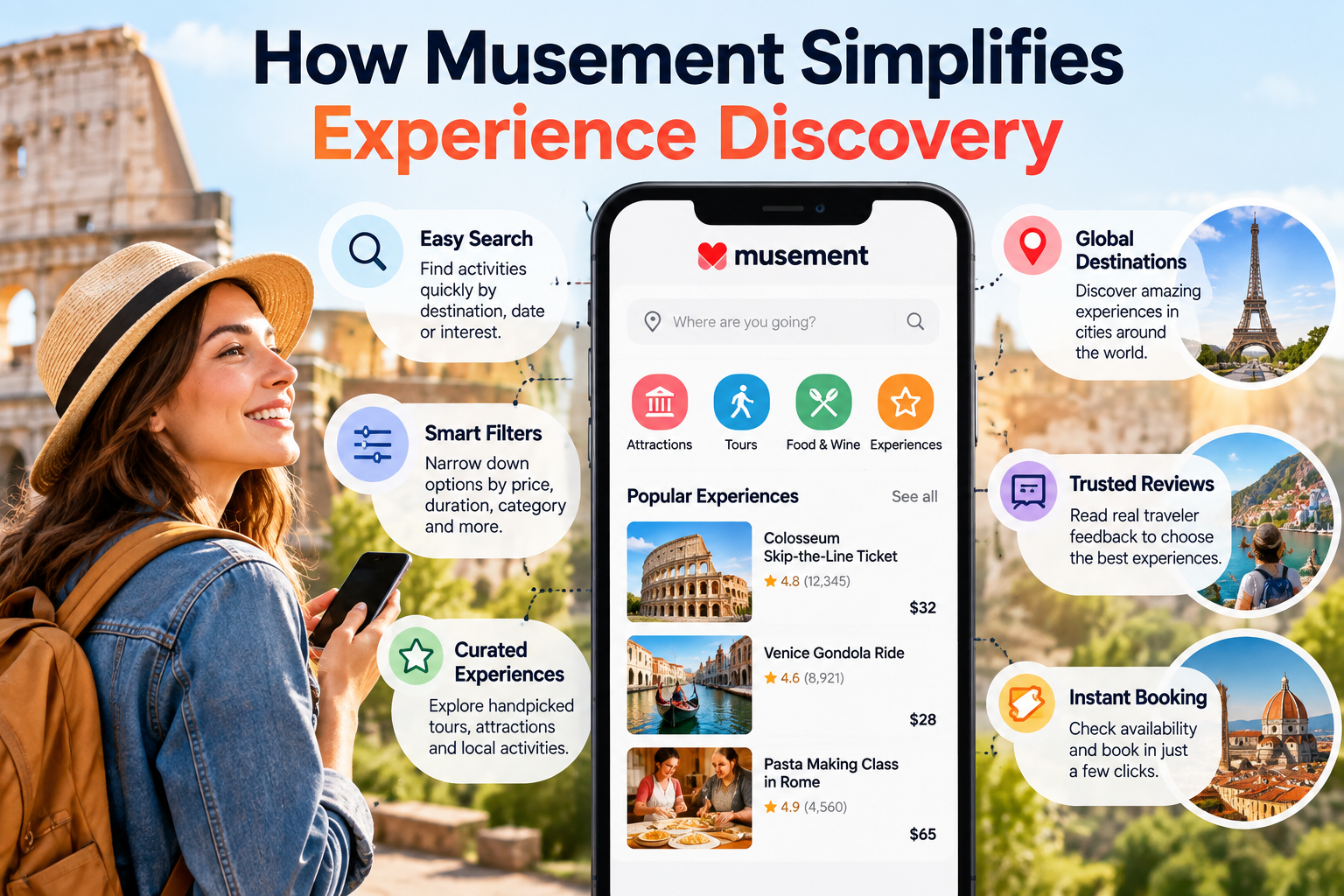
Musement fits into this broader movement by focusing on activities and experiences that travelers can discover and book digitally. Its usefulness starts with the simple fact that a destination contains far more possibilities than most travelers can realistically research manually. A person planning a trip may know they want “something cultural” or “a fun activity for the family” without knowing the exact product name to search for. An experience platform can help translate that broad intention into specific options. This makes discovery less dependent on already knowing the names of local tour operators. It can also help travelers move from inspiration to action more quickly. Rather than collecting ideas in one place and booking them elsewhere, the experience marketplace model attempts to connect discovery with availability and purchase. Musement’s booking guidance describes a process in which users select an activity or attraction, check availability, choose relevant options such as date and tour details, enter their information and complete the booking. For travelers, that creates a much more straightforward path from “this looks interesting” to “this is now part of my itinerary.”
Searching for Activities in One Place
One of the biggest advantages of an online experience marketplace is consolidation. Travelers can search for multiple kinds of activities without opening a separate website for every attraction or tour company. This matters because experience planning can become surprisingly fragmented. One attraction may have its own ticketing system, a walking tour may be sold through another provider, and a cooking class might use an entirely different booking process. When those systems are scattered, comparing them becomes difficult. A centralized platform can provide a common environment where travelers can explore different possibilities before deciding what fits their trip. This is particularly useful for people who do not have hours available for travel research. Instead of beginning with a dozen specific searches, they can start with a destination and browse categories that match their interests. The convenience may sound small, but these small reductions in friction accumulate quickly. A traveler who saves twenty minutes researching one activity and another twenty minutes researching a second activity has already created valuable planning time.
Filters That Help Narrow the Choices
The real challenge in travel planning is rarely a lack of choices; it is having too many choices. A major city can offer hundreds of tours, attractions and activities, and simply displaying all of them does not solve the traveler’s problem. Filters and categories help transform a huge catalog into a manageable shortlist. Depending on the platform and experience, travelers may be able to narrow options using destination, date, activity type, duration, traveler requirements, price or other characteristics. This is especially useful when planning around fixed schedules. If you have only one afternoon available, a long full-day excursion is obviously less useful than a two-hour activity. Likewise, families may need to consider age restrictions, while travelers with limited mobility may need to examine accessibility information before booking. The ability to narrow options encourages more intentional decisions. Rather than choosing the first attractive photograph that appears in search results, travelers can ask a more useful question: “Which experience actually fits the way I am traveling?” That shift from browsing to filtering can make online experience planning feel far less overwhelming.
Comparing Tours, Attractions, and Activities
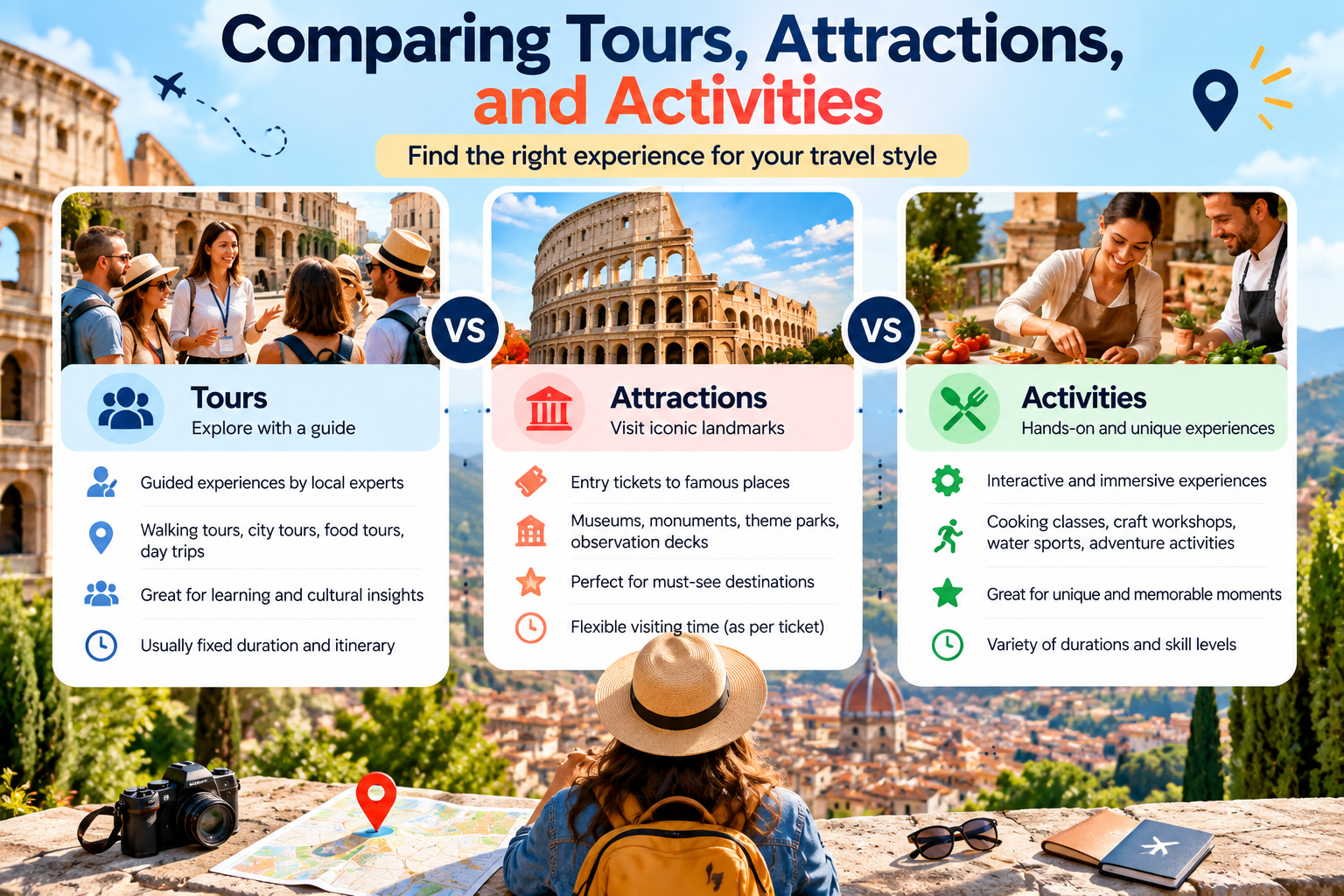
Comparison is another area where online platforms can save time. When activities are presented in a consistent format, travelers can more easily evaluate the differences between them. A traveler might compare a small-group walking tour with a private tour, or a standard attraction ticket with an option that includes additional access or services. The objective is not necessarily to find the cheapest option. A better goal is to identify the experience that offers the right combination of price, duration, convenience, reviews and features. This becomes particularly important for travelers with limited time. Paying slightly more for an activity that fits perfectly into an itinerary can sometimes be more valuable than choosing the lowest-priced option. Conversely, budget-conscious travelers can compare several possibilities before spending money. Online marketplaces therefore function somewhat like a comparison table for travel experiences. They make differences easier to notice and encourage people to consider value rather than simply purchasing the first available ticket.
Making Booking More Convenient
A well-designed booking process removes unnecessary steps between discovery and confirmation. Travelers generally want to know what they are buying, when they can use it, what it costs, what is included and what they need to do next. An online platform can organize those details around the booking decision rather than forcing users to hunt through several pages. Once a traveler has selected an experience, digital checkout can make the transaction relatively straightforward. Musement’s help documentation describes selecting an activity, checking availability, choosing applicable options, providing personal and payment information, and completing the booking. That sequence reflects an important principle of good travel technology: the platform should help the traveler move forward without creating unnecessary confusion. When the booking path is clear, travelers can spend more time thinking about the actual experience and less time worrying about administrative details. Convenience becomes especially valuable when people are planning several activities for the same trip.
Digital Tickets and Confirmation
Digital confirmation is another reason online experience platforms can simplify travel. Instead of carrying several paper tickets or visiting different ticket offices, travelers can often receive booking information electronically. Musement’s help center explains that a ticket voucher is provided by email after confirmation, with the specific instructions for using the voucher included in the booking information. This creates a useful digital trail for the traveler. The confirmation can be checked before leaving the hotel, during the journey to the attraction or immediately before the activity begins. It also makes it easier to keep multiple reservations organized in one email account or travel-planning workflow. Of course, travelers should still read the instructions carefully because voucher requirements vary between activities. Some may use mobile tickets, while others can require printing or following specific meeting-point instructions. The important advantage is that the booking information is accessible digitally rather than depending entirely on a physical ticket.
Planning Around Your Travel Itinerary
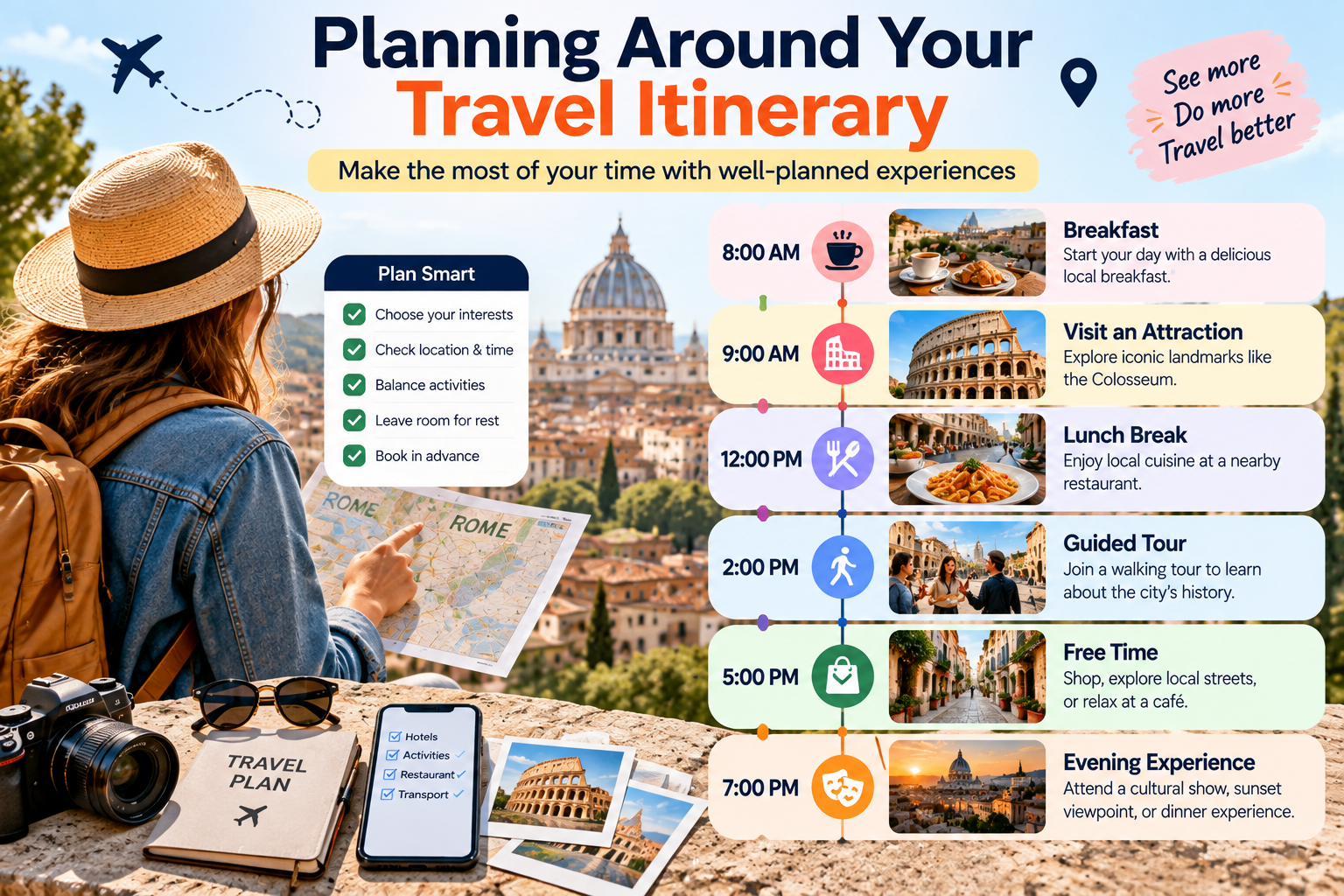
Experience booking becomes much more valuable when it is connected to the rest of the itinerary. A city trip might involve arriving in the morning, visiting an attraction in the afternoon, eating dinner nearby and attending an evening event. Without coordination, travelers can accidentally schedule activities too close together or choose experiences that require long journeys between locations. Online platforms can help by making the duration and scheduling information easier to consider before booking. This does not replace good judgment, but it gives travelers the information needed to build a realistic day. The idea is similar to assembling a puzzle: every experience has a time, location and duration, and the goal is to make the pieces fit without creating unnecessary stress. This becomes even more important for family trips and group travel because more people means more constraints. A centralized experience platform gives planners a place to research those activities before committing them to the itinerary, reducing the possibility of discovering scheduling conflicts at the destination.
Discovering Local and Authentic Experiences
Travelers increasingly want experiences that feel connected to the destination rather than generic activities that could happen anywhere. Local food, traditional crafts, neighborhood tours, cultural performances and hands-on workshops can provide that connection. Tripadvisor’s 2026 data highlights strong interest in craft classes and locally rooted cultural experiences, while its broader research suggests travelers are increasingly looking for meaningful connections with places they visit. Online platforms make these experiences easier to discover because local operators do not necessarily have the marketing reach of major attractions. A small cooking class might be difficult to find through a conventional search, while a structured experience marketplace can put it alongside better-known activities. This creates a more diverse travel-planning environment. Instead of building an itinerary entirely around famous landmarks, travelers can mix major attractions with smaller experiences that reveal another side of the destination. That combination can make a trip feel less like following a checklist and more like actually spending time in a place.
From Famous Attractions to Hidden Gems
Famous attractions remain important, but travelers are increasingly curious about alternatives. Tripadvisor reported that destinations outside its 100 most-booked locations grew more than twice as fast as the top 100 during the first half of 2026, suggesting increasing interest in places beyond traditional tourist hotspots. Experience platforms can support this broader discovery by exposing travelers to activities they may not have considered before. A person visiting a major city may initially search only for its best-known landmark, but browsing an experience marketplace can reveal food tours, neighborhood walks, workshops, river cruises, cultural events or day trips. This is valuable because discovery often depends on seeing possibilities you did not know existed. Search engines are excellent when you already know what you want, but marketplaces can be useful when you are still deciding. In that sense, experience platforms operate as both booking tools and inspiration engines. They help answer not just “Where can I buy this?” but also “What else could I do while I am here?”
Why Reviews and Ratings Matter
Choosing an experience involves uncertainty. Travelers are not simply buying an object they can inspect before purchase; they are buying a future moment that has not happened yet. Reviews and ratings can therefore provide useful context. They may help travelers understand whether an activity is suitable for families, how demanding a tour feels, whether a guide is engaging, or whether an attraction matches expectations. Reviews should not be treated as absolute truth because individual experiences naturally differ, but patterns across many reviews can reveal useful information. Tripadvisor’s 2026 data found that cooking classes, craft classes and dance lessons were among its highest-rated experience categories, with average ratings above 4.8 out of 5. This demonstrates why traveler feedback can influence decisions. A detailed review can answer practical questions that promotional descriptions sometimes cannot. For travelers, reading recent feedback before booking is one of the simplest ways to reduce uncertainty and choose an experience that better matches their expectations.
Helping Travelers Manage Time and Budget
Travel budgets are not only about money. Time is also a limited resource. Every day of a vacation has a finite number of hours, and an experience that consumes an entire day may prevent travelers from doing several smaller activities. Online experience platforms help travelers consider both financial and time costs while comparing options. This is especially useful as travelers become more value-conscious. A 2026 travel trend report from RVshare found that 87% of travelers were actively seeking ways to reduce costs, while shorter and more manageable trips were also becoming more attractive. For an experience planner, this means value matters. A good activity is not necessarily the cheapest activity; it is one that delivers an enjoyable experience without creating unnecessary financial or scheduling pressure. Digital comparison tools can help travelers balance those factors. Instead of buying everything that looks interesting, they can prioritize the experiences that are most meaningful and build a trip around them.
Last-Minute and Advance Experience Planning
One misconception about experience platforms is that they are useful only for travelers who plan months ahead. In reality, experience planning exists across a wide range of booking windows. Some travelers want to reserve popular activities well in advance because they do not want to risk missing out. Others make decisions after arriving at the destination and want something to do tomorrow or even later that day. Research from Phocuswright and Arival shows that booking behavior varies by experience type and that concerns about availability can encourage travelers to book ahead. This flexibility is important because different trips have different planning styles. A carefully scheduled family vacation may require reservations before departure, while a spontaneous city break might leave several afternoons open. Online platforms can support both approaches by allowing travelers to browse and book according to their circumstances. The best strategy is therefore not “always book early” or “always wait.” It is to understand which parts of your itinerary need certainty and which parts can remain flexible.
Discovering Ferry Routes and Travel Services Available With MrFerry DE
A Complete Guide to Understanding the Online Lottery Experience With Lottoland
How Digital Threats Are Driving Interest in Services Like Kaspersky.se
Exploring Affordable Home Décor and Furniture Solutions From IKEA
Smart Shopping Tips for Exploring Products From Havaianas ES
Tips for Getting More From Experience Platforms
Travelers can get better results from experience platforms by starting with their priorities rather than immediately searching for the most popular activity. Think about the kind of trip you want: cultural, adventurous, relaxing, family-focused, food-oriented, educational or a mixture of several styles. Then consider how much time and money you realistically have available. Read recent reviews, check the duration and meeting instructions, confirm the date and time, and pay attention to cancellation or voucher requirements before completing the purchase. It is also smart to avoid overloading every day with activities. A vacation needs breathing room, and an itinerary that looks perfect on paper can become exhausting in reality. Use the platform to create a shortlist, compare the options and reserve the experiences that genuinely add value to the trip. The objective is not to book the maximum number of activities. It is to create a trip where the experiences you choose feel worth the time, money and effort involved.
Conclusion
Online travel platforms like Musement make experience planning easier by bringing discovery, comparison, availability and booking closer together. Their value becomes particularly clear in a travel market where experiences are increasingly important but remain fragmented across countless local providers and offline channels. Current industry research shows that travelers are actively seeking meaningful activities, cultural connections, hands-on learning and experiences beyond traditional tourist hotspots, while online booking still represents a relatively small portion of the overall experience market. For travelers, this creates a compelling reason to use digital marketplaces as part of the planning process. Instead of treating activities as something to figure out after arriving, travelers can build experiences into the trip from the beginning. Whether you are planning a carefully organized vacation or leaving room for spontaneous discoveries, an experience platform can make the process more organized and less overwhelming. The biggest benefit is ultimately not the booking itself; it is the ability to spend less time managing travel logistics and more time looking forward to what you will actually experience.
Frequently Asked Questions
Q. What is Musement used for?
A. Musement is an online travel experience platform designed to help travelers discover and book activities, tours, attractions and other experiences in destinations around the world. It provides travelers with a centralized way to explore options rather than researching every experience provider independently.
Q. Why use an online platform for travel experiences?
A.An online platform can simplify the process of discovering, comparing and booking activities. Travelers can research different options, check availability and organize experiences around their itinerary without having to visit numerous unrelated websites.
Q. Should I book travel experiences in advance?
A. It depends on the experience and your itinerary. Popular attractions and activities with limited capacity may be worth reserving early, particularly if they are essential to your trip. Less critical activities can sometimes be left flexible so you can make decisions after arriving.
Q. Are reviews useful when choosing an experience?
A.Yes. Reviews can provide practical information about an experience that may not be obvious from its basic description. Look for recurring patterns across multiple recent reviews rather than relying on one exceptionally positive or negative opinion.
Q. How can experience platforms make travel planning less stressful?
A. They can reduce the number of separate searches and booking processes travelers need to manage. By bringing activities, availability, booking information and confirmation details into a more organized digital environment, they can make the planning process easier to follow from inspiration through the actual trip.
Table of Contents
Related Posts