Customer.io vs Competitors: Which Marketing Automation Platform Is Best?
Marketing automation has become one of the most important tools for businesses that want to create meaningful customer relationships while saving time and improving efficiency. In today’s competitive digital environment, companies cannot depend only on manual emails, basic newsletters, or traditional marketing campaigns. Customers expect personalized communication, quick responses, and relevant messages based on their interests and behavior. This is where marketing automation platforms help brands deliver the right message to the right person at the right time.
Among the many platforms available today, Customer.io has gained attention because of its powerful automation workflows, behavioral targeting, and developer-friendly approach. However, it is not the only option available. Businesses also compare it with popular alternatives such as HubSpot Marketing Hub, Mailchimp, Klaviyo, ActiveCampaign, and Braze to find the best solution for their needs.
Choosing the right marketing automation platform is similar to selecting the engine for a vehicle. A powerful engine can help you travel faster, but the best choice depends on your destination, budget, and requirements. A small startup may need flexibility and affordability, while a large enterprise may prioritize advanced analytics, integrations, and customer journey management.
In this detailed comparison, we will explore Customer.io vs competitors, analyze features, pricing approaches, usability, advantages, limitations, and help you decide which marketing automation platform fits your business goals.
Table of Contents
Understanding Customer.io and Modern Marketing Automation
What Is Customer.io?
Customer.io is a customer engagement and marketing automation platform designed to help businesses communicate with users through personalized and behavior-based messaging. Unlike traditional email marketing tools that mainly focus on sending campaigns to lists, Customer.io focuses on understanding customer actions and creating automated experiences based on real-time behavior.
The platform allows companies to send messages through multiple channels, including email, push notifications, SMS, and in-app messages. Businesses can create workflows that automatically respond to customer activities, such as signing up for an account, abandoning a shopping cart, completing a purchase, or interacting with a product feature.
One of the biggest strengths of Customer.io is its ability to use customer data effectively. Instead of treating every user the same, companies can divide audiences into specific groups based on interests, actions, location, purchase history, or engagement level. This allows marketers to create campaigns that feel more personal and relevant.
For example, imagine an online education platform. A user who creates an account but never starts a course could receive an automated reminder with recommended courses. Another user who completes multiple lessons might receive advanced learning suggestions. Customer.io helps businesses build these personalized experiences automatically.
The platform is especially popular among SaaS companies, technology startups, subscription businesses, and digital products because these businesses often depend on user engagement and retention. Developers also appreciate Customer.io because it provides flexible APIs and integrations that allow teams to connect customer data from different sources.
Why Businesses Need Marketing Automation Platforms
Modern customers interact with brands across many different channels. They may discover a product through social media, visit a website, download an app, receive emails, and make purchases through different devices. Managing these interactions manually becomes difficult as a business grows.
Marketing automation platforms solve this challenge by creating organized systems for customer communication. Instead of manually sending hundreds or thousands of messages, businesses can create automated campaigns that run continuously.
Some major benefits of marketing automation include:
- Improved customer personalization
- Higher engagement rates
- Better lead nurturing
- Reduced marketing workload
- More accurate customer insights
- Increased sales opportunities
A good automation platform acts like a smart assistant that works behind the scenes. It monitors customer behavior, identifies opportunities, and delivers messages without requiring constant human involvement.
For example, a customer who visits a pricing page several times but does not purchase may receive educational content explaining product benefits. A customer who has not used a service recently may receive a re-engagement campaign. These small interactions can significantly improve customer relationships over time.
Businesses today are not only competing on products or prices; they are competing on experiences. Marketing automation helps brands create smoother and more personalized customer journeys.
Key Features of Customer.io
Customer Data Management and Segmentation
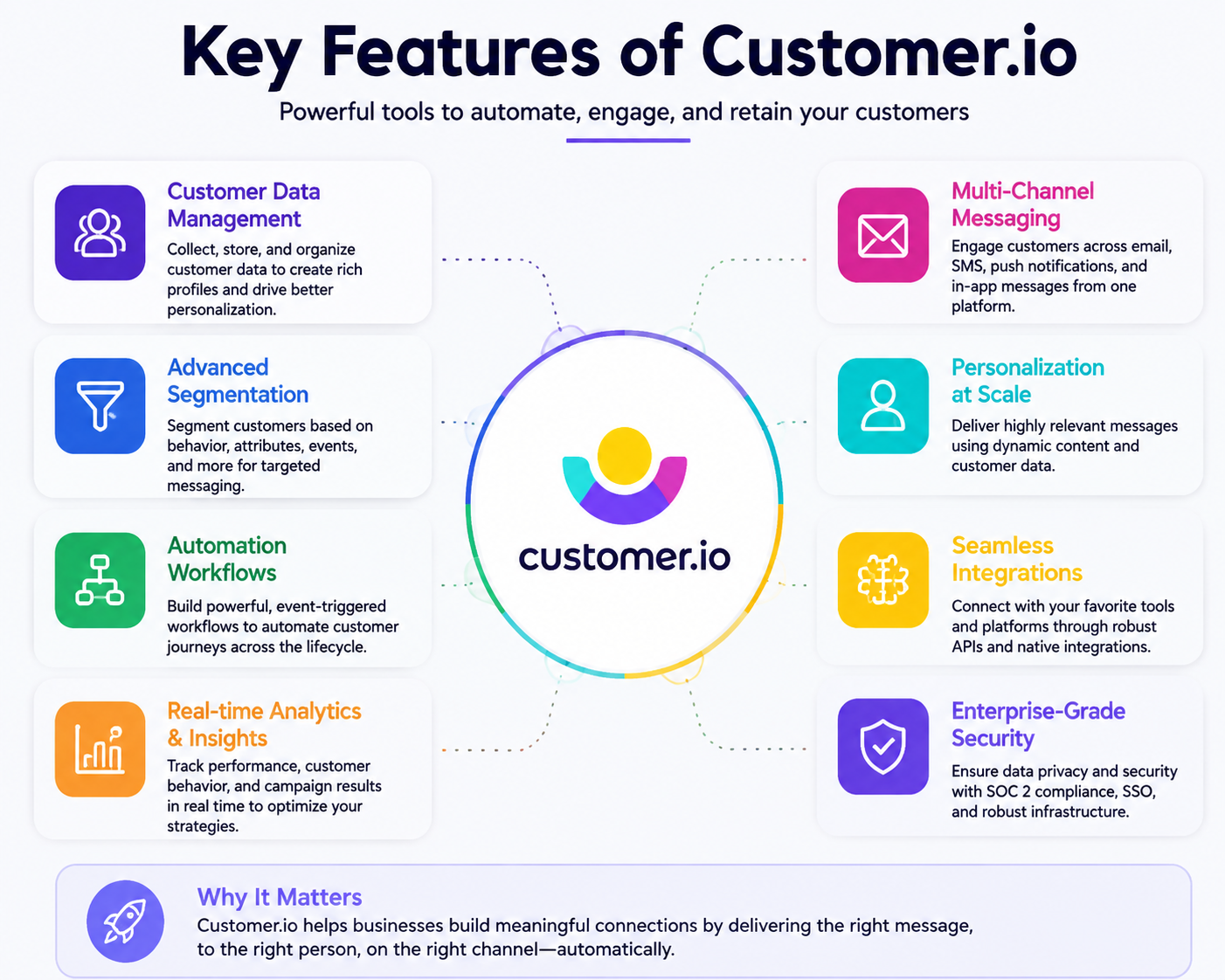
One of the strongest features of Customer.io is its customer data management capability. Effective marketing depends on understanding customers, and Customer.io allows businesses to collect and organize important user information in one place.
The platform allows marketers to create detailed customer segments using different conditions. These segments can be based on demographic information, user behavior, engagement patterns, purchase history, or custom attributes.
For example, an e-commerce company can create segments such as:
- New customers who purchased within the last 30 days
- Customers who abandoned their shopping carts
- High-value customers with frequent purchases
- Users who have stopped interacting with the brand
This level of segmentation allows businesses to avoid sending irrelevant messages. Instead of sending the same promotional email to everyone, companies can create targeted communication strategies.
Personalization has become a major factor in marketing success. Customers are more likely to engage with brands that understand their needs. A message that feels personally relevant can create stronger connections than a generic advertisement.
Customer.io helps businesses move from simple email broadcasting to intelligent customer communication.
Multi-Channel Messaging Capabilities
Modern customers do not communicate with brands through only one channel. A person may read an email in the morning, receive a mobile notification during the day, and interact with an in-app message while using a product. Because customer behavior is spread across different platforms, businesses need marketing automation tools that can manage communication across multiple channels.
Customer.io provides businesses with the ability to create coordinated campaigns across email, push notifications, SMS, and in-app messaging. This allows marketers to design complete customer journeys instead of isolated messages. For example, a company can send a welcome email after registration, follow it with a push notification encouraging product usage, and later send an SMS reminder if the customer becomes inactive.
This multi-channel approach creates a smoother experience because customers receive messages through channels they are most comfortable using. Instead of relying only on email open rates, businesses can combine multiple communication methods to increase engagement.
Another important advantage is automation flexibility. Marketers can create rules based on customer actions. If a user clicks a particular email link, the next message can automatically change. If a customer completes a specific action inside an application, the communication journey can move to the next stage.
This behavioral approach is different from traditional marketing campaigns where everyone receives identical messages. Customer.io focuses on creating conversations rather than simply sending advertisements.
Email, Push Notifications, SMS, and In-App Messaging
Email Marketing Automation
Email remains one of the most effective digital marketing channels, and Customer.io provides advanced tools for creating automated email campaigns. Businesses can design onboarding sequences, product announcements, promotional campaigns, and retention emails.
The platform supports personalized content, allowing companies to include customer-specific information in messages. For example, an online store can recommend products based on previous purchases, while a SaaS company can share tips based on user activity.
Push Notifications
Push notifications are valuable for mobile applications because they allow businesses to communicate instantly with users. Customer.io enables companies to send targeted notifications based on user behavior.
Instead of sending unnecessary alerts, businesses can create meaningful notifications such as:
- Reminders about incomplete actions
- New feature announcements
- Personalized recommendations
- Time-sensitive offers
SMS Marketing
SMS remains a powerful communication channel because text messages usually receive high visibility. Customer.io allows businesses to use SMS for important updates, reminders, promotions, and customer support communication.
For industries such as healthcare, finance, travel, and e-commerce, SMS automation can improve customer experience by providing timely information.
In-App Messaging
In-app messages help businesses communicate directly while users are actively using a product. These messages can guide new users, highlight features, or encourage specific actions.
For example, a software company can display a message explaining a new dashboard feature when users log into the application. This type of communication improves product adoption and reduces confusion.
Customer.io vs HubSpot Marketing Hub
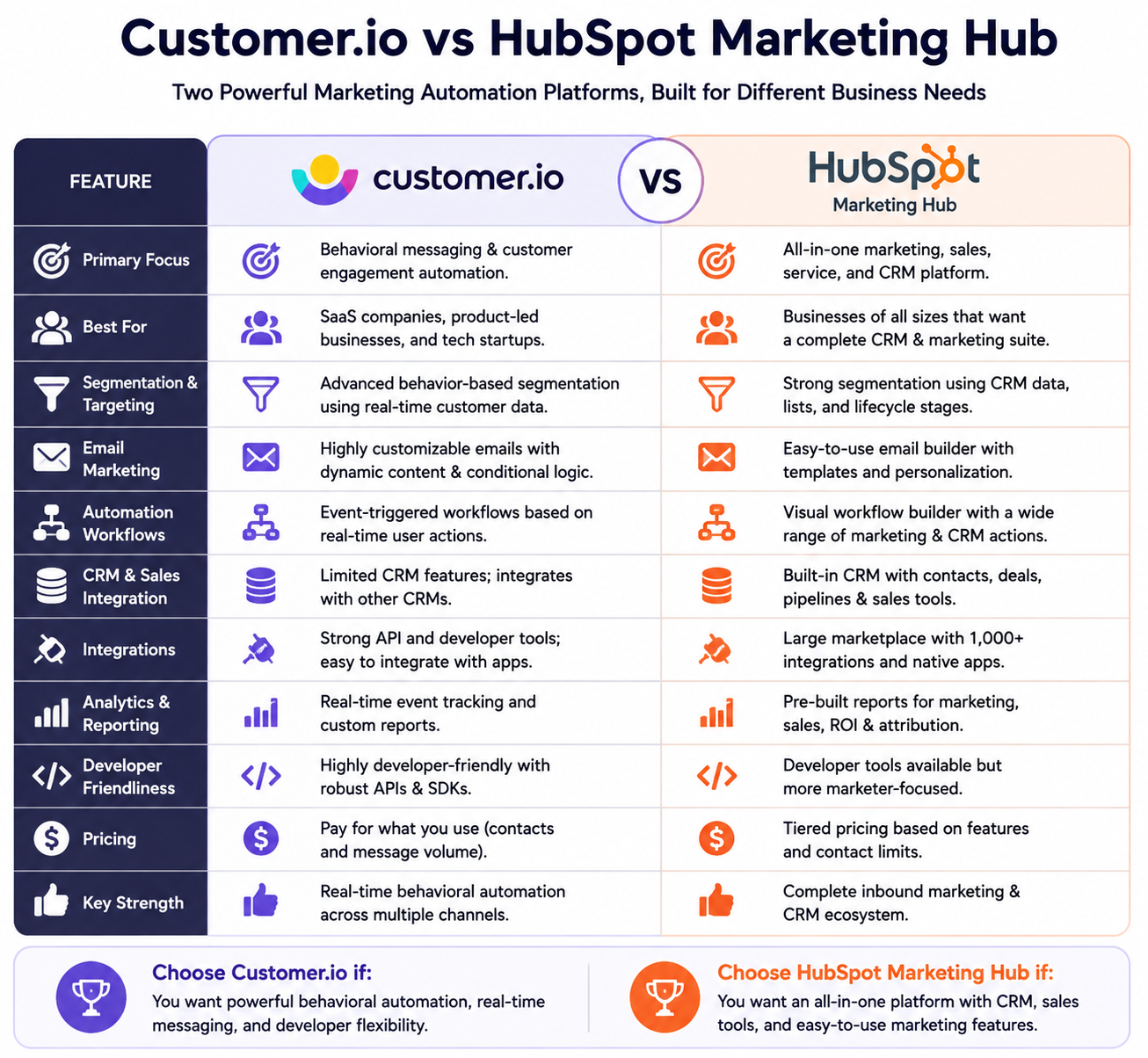
HubSpot is one of the most recognized names in marketing automation. It provides a complete ecosystem that combines marketing, sales, customer service, CRM, and analytics tools.
Customer.io and HubSpot serve slightly different audiences. Customer.io focuses heavily on behavioral messaging and product-led growth, while HubSpot provides a broader business management platform.
Feature | Customer.io | HubSpot Marketing Hub |
Main Focus | Behavioral messaging and automation | Complete CRM and marketing ecosystem |
Best For | SaaS companies, startups, product teams | Businesses needing CRM + marketing tools |
Customer Segmentation | Advanced behavioral segmentation | Strong CRM-based segmentation |
Ease of Use | Requires some technical understanding | Beginner-friendly interface |
Developer Flexibility | Very strong APIs | Good integrations |
CRM Features | Limited | Extensive CRM capabilities |
Customer.io is often preferred by companies that already have customer data systems and want powerful messaging automation. HubSpot is usually better for organizations that want everything in one place, including sales pipelines, customer records, and marketing campaigns.
A growing SaaS company may choose Customer.io because user behavior is central to its growth strategy. A traditional business with sales teams may prefer HubSpot because of its complete CRM environment.
Customer.io vs Mailchimp
Mailchimp is one of the most popular email marketing platforms, especially among small businesses and creators.
Mailchimp is known for simplicity. It allows users to create newsletters, promotional emails, and basic automation without needing advanced technical skills.
Customer.io, however, provides deeper behavioral automation.
Feature | Customer.io | Mailchimp |
Automation Level | Advanced workflows | Basic to medium automation |
User Behavior Tracking | Strong | Limited compared to Customer.io |
Email Design Tools | Good | Excellent beginner-friendly tools |
Target Users | Growing technology companies | Small businesses and creators |
Multichannel Support | Strong | Mainly email-focused |
Mailchimp works well for businesses that mainly need newsletters and simple campaigns. For example, a local business sending weekly updates may find Mailchimp perfectly suitable.
Customer.io becomes more valuable when companies need complex customer journeys. A subscription-based software company managing thousands of user actions will benefit from Customer.io’s advanced automation capabilities.
Comparing Pricing, Scalability, and Ease of Use
Pricing is an important factor when selecting marketing automation software. Businesses need a platform that fits their current budget while allowing future growth.
Customer.io generally follows a pricing structure based on factors such as customer profiles, messaging volume, and required features. This approach allows companies to scale according to their audience size.
The platform is designed for businesses that value flexibility and advanced automation. However, companies with very simple marketing needs may find some features unnecessary.
Platform | Pricing Approach | Best Value For |
Customer.io | Based on usage and audience size | Growing digital companies |
HubSpot | Subscription tiers | Businesses needing CRM solutions |
Mailchimp | Audience and feature-based plans | Small businesses |
Klaviyo | Contact-based pricing | E-commerce brands |
When comparing value, businesses should not only look at monthly costs. The real question is: How much revenue and efficiency can the platform generate?
A cheaper tool that cannot support advanced campaigns may cost more in the long run. A slightly more expensive platform that improves customer retention and conversions may provide better returns.
Customer.io vs Major Marketing Automation Competitors
The marketing automation industry includes many powerful platforms. While Customer.io offers impressive flexibility, businesses often compare it with established competitors to determine which tool provides the best value.
The right choice depends on several factors:
- Business size
- Marketing goals
- Technical requirements
- Budget
- Required integrations
- Level of automation complexity
Let’s compare Customer.io with some of the most popular alternatives.
Customer.io Advantages and Limitations
Choosing a marketing automation platform requires understanding both its strengths and weaknesses. Every tool has specific areas where it performs exceptionally well and areas where another platform may be a better fit. Customer.io has built a strong reputation among companies that want advanced automation, flexible customer journeys, and deeper control over communication strategies.
However, it is not designed for every type of business. A small company looking for a simple newsletter tool may find Customer.io more advanced than necessary, while a large enterprise may require additional enterprise-level features. Understanding these advantages and limitations helps businesses make a smarter decision.
Reasons Companies Choose Customer.io
One of the biggest reasons businesses choose Customer.io is its focus on behavior-based marketing automation. Traditional email marketing platforms often depend on contact lists and scheduled campaigns, but Customer.io allows companies to react to real customer actions.
For example, a user signs up for a free trial but does not complete the onboarding process. Customer.io can automatically identify this behavior and send a personalized message encouraging the user to continue. If the user completes onboarding, the workflow can automatically change and provide advanced product information.
This type of automation creates experiences that feel natural rather than promotional.
Another major advantage is flexibility. Customer.io provides tools that allow marketing teams and developers to work together. Developers can send customer events through APIs, while marketers can create campaigns without constantly depending on technical teams.
This makes it especially valuable for technology companies where customer behavior data plays a major role in growth.
Some important advantages include:
- Advanced customer segmentation
- Real-time behavioral tracking
- Multi-channel communication
- Powerful automation workflows
- Developer-friendly integrations
- Personalized customer experiences
Customer.io also supports testing and optimization. Businesses can experiment with different messages, timing strategies, and customer journeys to discover what creates better engagement.
Marketing today is not about sending more messages; it is about sending smarter messages. Customer.io helps companies achieve that goal by combining customer data with automation.
Areas Where Customer.io Can Improve
Although Customer.io is powerful, it also has certain limitations. Understanding these challenges is important before choosing the platform.
The first limitation is the learning curve. Because Customer.io provides advanced features, beginners may need time to understand workflows, segmentation rules, event tracking, and automation logic.
A small business owner who only wants to send weekly newsletters may find simpler tools easier to manage. Platforms like Mailchimp provide more beginner-friendly interfaces for basic email marketing.
Another limitation is that Customer.io depends heavily on good customer data. The platform becomes most powerful when businesses properly track user actions and maintain organized data. Companies without technical resources may struggle to set up advanced tracking.
Customer.io may also not provide the same level of built-in CRM functionality as platforms like HubSpot. Businesses that need sales management, customer relationship tracking, and marketing automation in one solution may prefer an all-in-one platform.
Some potential limitations include:
Area | Customer.io Challenge |
Beginner Experience | Requires more learning compared to simple email tools |
CRM Features | Not as extensive as dedicated CRM platforms |
Setup Requirements | Advanced tracking may need developer support |
Small Businesses | May offer more features than necessary |
The best marketing automation platform is not always the one with the most features. It is the one that matches the company’s actual requirements.
Who Should Choose Customer.io?
Customer.io is best suited for businesses that want advanced personalization and automated customer journeys. It is particularly useful for companies where user engagement directly affects revenue.
Different industries can benefit from Customer.io in different ways.
Best Use Cases for Startups, SaaS Companies, and Enterprises
Startups
Startups often need to grow quickly while using limited resources. Customer.io helps startups automate communication without building large marketing teams.
A startup can use Customer.io for:
- User onboarding
- Trial conversion campaigns
- Product education
- Customer retention
- Re-engagement campaigns
For example, a new software startup can automatically guide users from account creation to becoming active customers.
Instead of manually contacting every user, automation handles thousands of interactions while maintaining personalization.
SaaS Companies
Software-as-a-Service companies are among the strongest users of Customer.io because their success depends heavily on user activity.
SaaS companies can track events such as:
- Feature usage
- Login frequency
- Subscription changes
- Account upgrades
- User inactivity
Based on these actions, companies can create targeted campaigns.
For example:
A customer who frequently uses basic features may receive information about premium features. A customer who has not logged in for two weeks may receive a helpful reminder.
These small automated interactions can improve customer retention and increase lifetime value.
E-Commerce Businesses
Although platforms like Klaviyo are highly specialized for e-commerce, Customer.io can still support online stores that require flexible customer communication.
Businesses can create campaigns for:
- New customer onboarding
- Order updates
- Customer loyalty programs
- Product education
- Customer feedback requests
Companies with unique customer journeys may prefer Customer.io because of its flexibility.
Large Enterprises
Enterprise companies often manage complex customer communication systems involving millions of users. Customer.io can support organizations that need scalable automation and advanced segmentation.
Large businesses can integrate Customer.io with existing databases, applications, and analytics systems to create personalized experiences across different customer groups.
However, enterprises should carefully evaluate security requirements, compliance needs, and integration capabilities before making a final decision.
How to Get Started with Thryv: A Beginner’s Step-by-Step Guide
Is Ivacy VPN Worth It? A Complete Review for Privacy-Conscious Users
Top Reasons to Shop at SwimOutlet.com for Swimwear and Accessories
Best Gaia Herbs Products for Immune Support, Stress Relief, and Overall Health
Curated Crowd: The Ultimate Guide to Building a Targeted Audience
Customer.io vs Competitors: Final Comparison
After comparing Customer.io with leading competitors, it becomes clear that there is no single platform that is perfect for every business.
Each tool has a different purpose.
Platform | Best For | Main Strength |
Customer.io | SaaS companies and product-led businesses | Advanced behavioral automation |
HubSpot | Businesses needing CRM + marketing | Complete business ecosystem |
Mailchimp | Small businesses and creators | Simple email marketing |
Klaviyo | E-commerce brands | Revenue-focused customer campaigns |
ActiveCampaign | Small and medium businesses | Marketing automation + CRM |
Customer.io stands out because of its flexibility and focus on customer behavior. It allows companies to create personalized communication based on what users actually do, not just who they are.
For businesses that depend on product engagement, subscriptions, or user retention, Customer.io can be an excellent choice.
However, companies looking for a simple email newsletter solution or a complete CRM system may find other platforms more suitable.
The best choice depends on answering a few important questions:
- Do you need advanced behavioral automation?
- Do you require built-in CRM features?
- Are your campaigns mainly email-based or multi-channel?
- Do you have technical resources for setup?
- How complex are your customer journeys?
By understanding these factors, businesses can select a platform that supports long-term growth.
Conclusion
Marketing automation has become essential for businesses that want to create stronger customer relationships and improve marketing efficiency. Among modern automation platforms, Customer.io provides a powerful solution for companies that need advanced personalization, behavioral targeting, and flexible customer journeys.
Compared with competitors, Customer.io’s biggest advantage is its ability to respond to real-time customer actions. It allows businesses to move beyond basic email campaigns and create meaningful experiences across multiple communication channels.
While platforms like HubSpot, Mailchimp, and Klaviyo may be better choices for specific business models, Customer.io remains a strong option for SaaS companies, startups, and technology-focused organizations that value data-driven marketing.
The right marketing automation platform should not only help you send messages; it should help you understand customers, build trust, and create experiences that encourage long-term loyalty.
If your business depends on customer engagement and personalized communication, Customer.io can be a valuable investment. If your needs are simpler, another platform may provide better value.
The best platform is the one that fits your strategy, supports your customers, and helps your business grow.
Frequently Asked Questions
Q. What is Customer.io mainly used for?
A. Customer.io is mainly used for automated customer communication based on user behavior. Businesses use it to create personalized email campaigns, push notifications, SMS messages, and customer journeys triggered by real-time actions.
Q. Is Customer.io better than Mailchimp?
A. Customer.io and Mailchimp serve different purposes. Mailchimp is better for simple email newsletters and basic campaigns, while Customer.io is stronger for advanced automation, segmentation, and behavior-based messaging.
Q. Is Customer.io suitable for small businesses?
A. Yes, but it depends on the business needs. Small businesses that require advanced automation can benefit from Customer.io, but those looking for simple email marketing may prefer easier platforms.
Q. Does Customer.io support multiple marketing channels?
A. Yes. Customer.io supports several communication channels, including email, SMS, push notifications, and in-app messaging, allowing businesses to create complete customer journeys.
Q. Which businesses benefit most from Customer.io?
A. Customer.io is especially useful for SaaS companies, startups, subscription businesses, and technology companies that rely on user engagement, retention, and personalized customer experiences.
Table of Contents
Related Posts