
Everything You Need to Know About International Transfers with Monito
Sending money internationally has become a normal part of modern life. Whether you are supporting family members abroad, paying for overseas education, managing a remote business, or simply traveling between countries, international transfers play an important role in global finance. However, choosing the right service can often feel confusing because every provider advertises different fees, exchange rates, delivery speeds, and benefits. One service may promise low fees, another may highlight instant transfers, while a third may claim to offer better currency exchange rates. This is where Monito international transfers become useful.
Monito is designed to help users compare different money transfer services before making a decision. Instead of manually checking dozens of providers, users can compare available options in one place and identify services that may offer better value. The platform compares transfer companies, exchange rates, fees, and delivery methods to help people make informed choices.
In a world where even a small exchange rate difference can significantly affect the final amount received, having a comparison tool can make international payments simpler and more transparent. This guide explains everything you need to know about using Monito for international transfers, including how it works, its benefits, potential limitations, and tips for getting the best results.
Table of Contents
Understanding International Money Transfers
International money transfers involve sending funds from one country to another, usually through banks, digital payment companies, or specialized remittance providers. Unlike domestic transfers, international transactions require currency conversion, additional verification processes, and connections between financial institutions in different countries.
For example, someone living in the United States sending money to family in India is not simply transferring dollars from one account to another. The transaction involves converting USD into INR, applying an exchange rate, processing international payment networks, and ensuring regulatory compliance. Each step can influence the final amount received.
Many people assume that the transfer fee shown on a provider’s website represents the complete cost. However, the actual cost often includes another important factor: the exchange rate margin. A company may advertise a low fee but provide a less favorable exchange rate, meaning the sender still pays more overall.
This is why comparing international transfers requires looking beyond simple fees. The best service is usually the one that provides the highest amount received by the recipient after all charges and currency conversion differences are considered.
Why People Send Money Across Borders
There are countless reasons why people need international transfer services today. Global migration, remote employment, international education, and online businesses have created a growing demand for fast and affordable money movement.
Some common reasons include:
- Supporting family members living overseas
- Paying international tuition fees
- Sending money while traveling
- Paying foreign suppliers or freelancers
- Managing overseas investments
- Purchasing property abroad
For many immigrants and expatriates, international transfers are not occasional transactions but an essential financial activity. They need services that are reliable, affordable, and easy to access.
Businesses also depend heavily on international payment solutions. A company working with international contractors may need to send payments regularly across multiple countries. Choosing an expensive transfer provider can create unnecessary costs over time, making comparison tools increasingly valuable.
Common Challenges With International Transfers
Although sending money abroad is easier than ever, several challenges remain. One of the biggest issues is understanding the real cost of a transaction.
Different providers may use different pricing structures. Some charge fixed fees, some charge percentage-based fees, and others earn through currency exchange markups. This makes direct comparisons difficult for the average user.
Another challenge is speed. Some transfers arrive within minutes, while others may take several business days. The fastest option is not always the cheapest, and the cheapest option may not always meet urgent needs.
Security is another major concern. People want assurance that their money is handled safely and that the provider they choose follows proper financial regulations.
This is the problem Monito attempts to solve by organizing important information about multiple transfer providers in one place.
What Is Monito and How Does It Work?
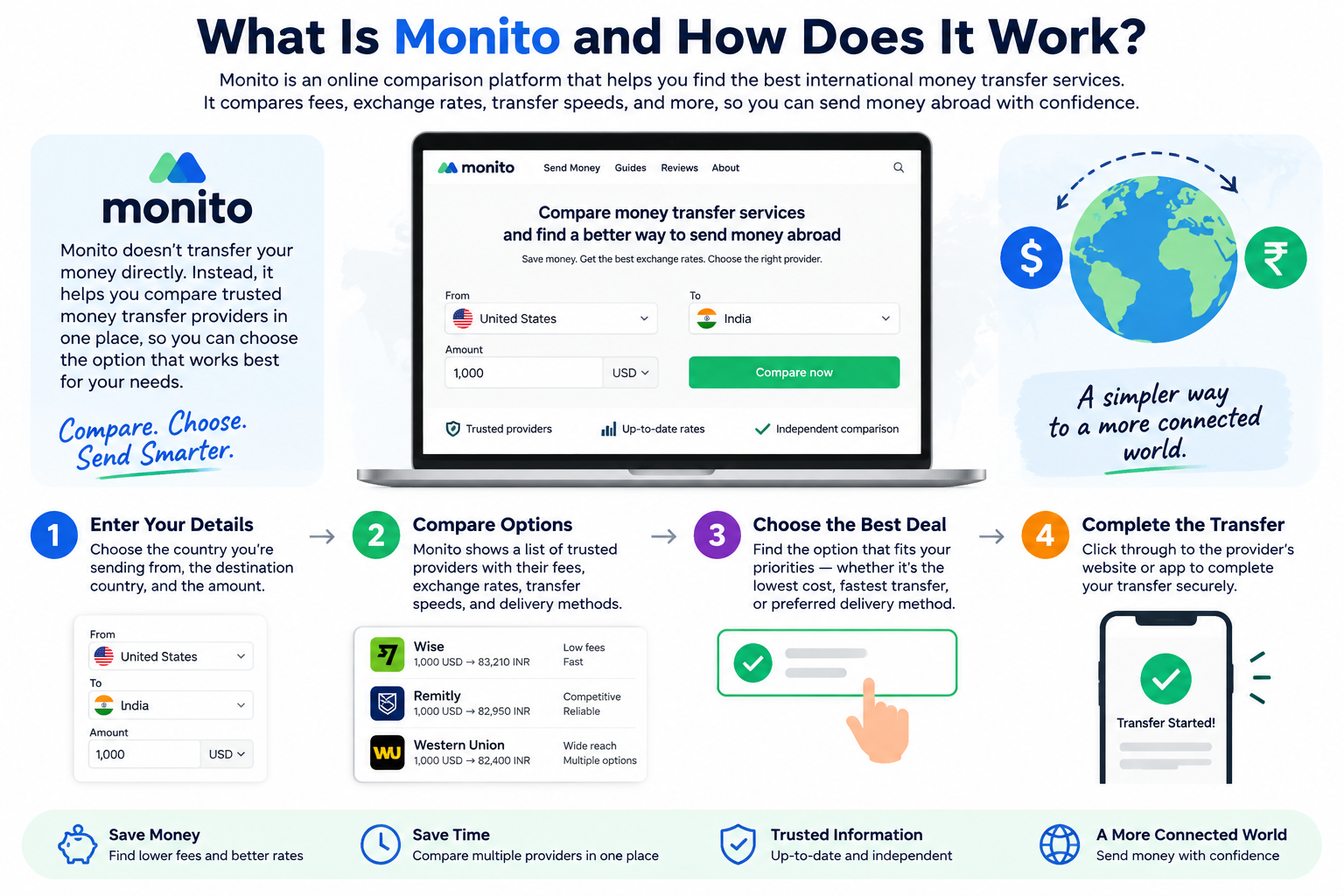
Monito is an online comparison platform that helps users compare international money transfer services. It does not directly move money between countries. Instead, it works as a comparison tool that helps users find suitable providers based on their transfer requirements.
Think of Monito as a search engine for international transfers. Instead of searching individually through multiple websites, users enter their transfer details once and receive a comparison of available options.
According to available information, Monito allows users to compare many money transfer providers, including popular services such as Wise, Western Union, Remitly, Revolut, and others.
The platform considers several factors, including:
- Sending country
- Receiving country
- Transfer amount
- Currency exchange rates
- Transfer fees
- Delivery methods
- Transfer speed
This approach helps users understand which provider may offer the best overall deal for their specific situation.
Monito as a Money Transfer Comparison Platform
The biggest advantage of Monito is that it simplifies comparison. Instead of opening multiple websites and calculating costs manually, users can view different options together.
For example, imagine you want to send $1,000 internationally. Provider A may charge a $5 fee but offer a weaker exchange rate. Provider B may charge $10 but provide a better currency conversion rate. Without comparing the complete cost, it is difficult to know which option is actually cheaper.
Monito helps highlight these differences by showing users the expected cost and outcome of different transfer options.
The platform is especially useful because international transfer pricing changes frequently. Exchange rates move constantly, and promotional offers may appear or disappear. Having updated comparisons helps users avoid relying on outdated information.
How Monito Helps Users Find Better Deals
Monito helps users make decisions based on real transfer needs rather than marketing claims. A provider advertising “zero fees” may not necessarily provide the best deal if its exchange rate is unfavorable.
By comparing multiple services, users can evaluate:
- How much money the recipient will actually receive
- How long the transfer will take
- Whether cash pickup or bank deposit is available
- Whether additional charges apply
This makes the process more transparent and gives users greater control over their financial choices.
For frequent international senders, even a small improvement in exchange rates can create meaningful savings over time.
Key Features of Monito for International Transfers
Comparing Transfer Providers
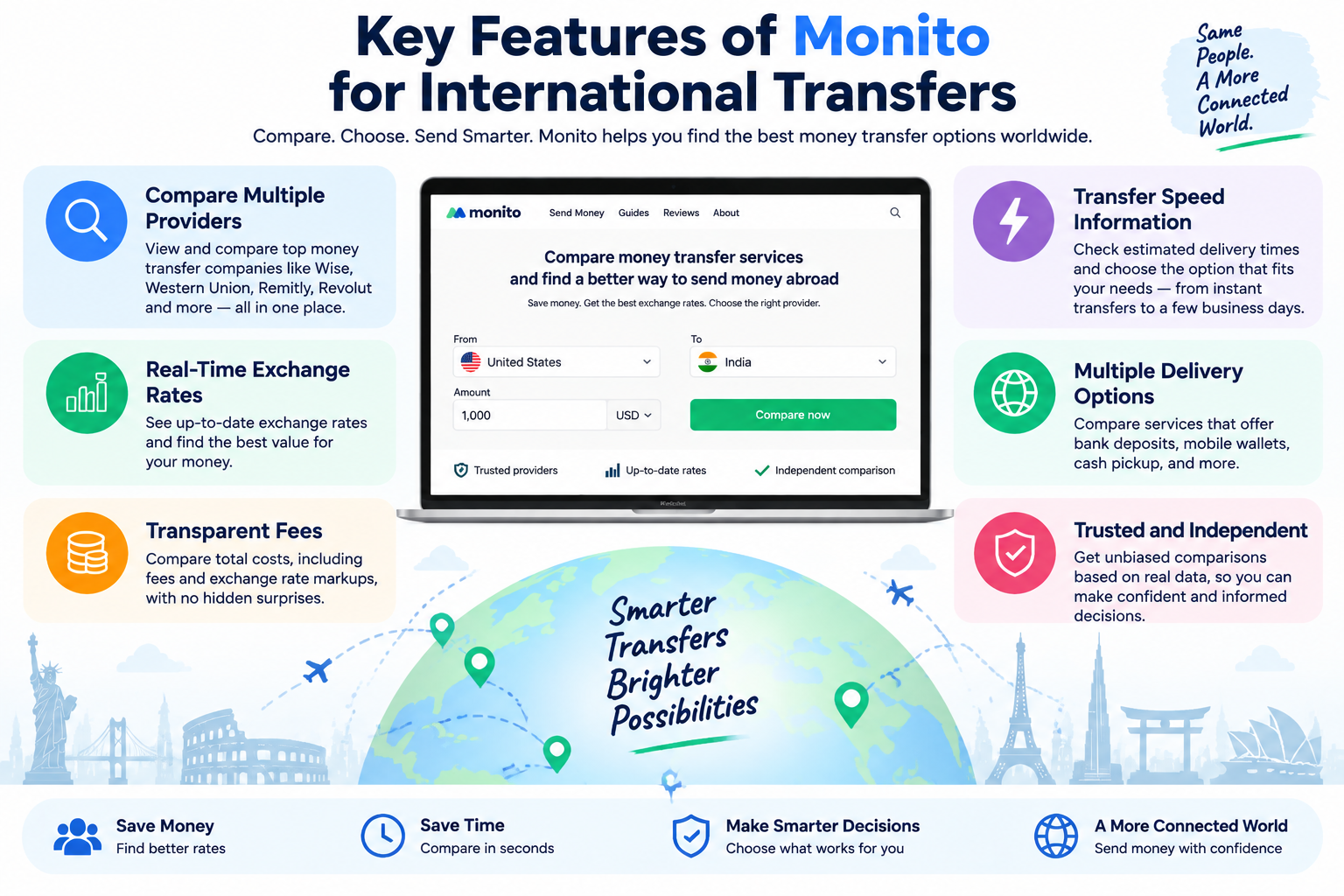
The core feature of Monito is its ability to compare multiple international transfer providers. Users can enter their transfer details and view different available services.
This comparison saves time because users do not need to research each company separately. Instead, they can quickly identify providers that match their priorities.
Some users may prioritize speed, while others may focus on cost savings. Monito allows people to evaluate options according to their personal needs.
Exchange Rate Tracking and Cost Transparency
Exchange rates are one of the most important parts of international transfers. A small difference in currency conversion can affect the final amount received.
Monito helps users understand exchange rate differences between providers. This is valuable because many transfer companies include their profit margin within the exchange rate rather than showing it as a separate fee.
A transparent comparison helps users avoid choosing a service based only on advertised fees.
Transfer Speed and Delivery Options
Different transfer providers offer different delivery methods. Some support:
- Bank deposits
- Mobile wallets
- Cash pickup
- Card transfers
The best choice depends on the recipient’s location and personal preference.
For example, someone receiving money in a major city may prefer direct bank transfer, while someone without easy banking access may prefer cash pickup.
How to Use Monito for Sending Money Internationally
Using Monito is generally a straightforward process.
Step-by-Step Process
- Enter your sending country and destination country.
- Select the amount you want to transfer.
- Compare available providers.
- Review fees, exchange rates, and delivery times.
- Choose the provider that fits your requirements.
- Complete the transfer through the selected provider’s website or app.
The important point is that Monito helps you compare before you commit. The actual transaction is completed with the chosen transfer provider.
Choosing the Right Transfer Provider
The cheapest option is not always the best option. Before selecting a provider, consider:
- Transfer urgency
- Recipient’s preferred payment method
- Customer support quality
- Provider reputation
- Regulatory compliance
A slightly more expensive service may be better if it provides faster delivery or stronger reliability.
Understanding Fees and Exchange Rates With Monito
International transfer costs usually come from two sources:
Cost Factor | Explanation |
Transfer Fee | The direct charge for processing the transaction |
Exchange Rate Margin | The difference between the market exchange rate and the rate offered by the provider |
Many users focus only on the visible transfer fee. However, the exchange rate margin can sometimes have a bigger impact on the final cost.
For example, a service offering a free transfer may still cost more if it provides a poor exchange rate.
Hidden Costs in International Transfers
Hidden costs are one of the biggest problems in global payments. Some providers highlight attractive offers but do not clearly explain the complete pricing structure.
Before sending money, always check:
- Total amount received
- Exchange rate applied
- Possible taxes
- Additional banking charges
A comparison platform like Monito helps users identify these differences before making a payment.
Benefits of Using Monito for Global Transfers
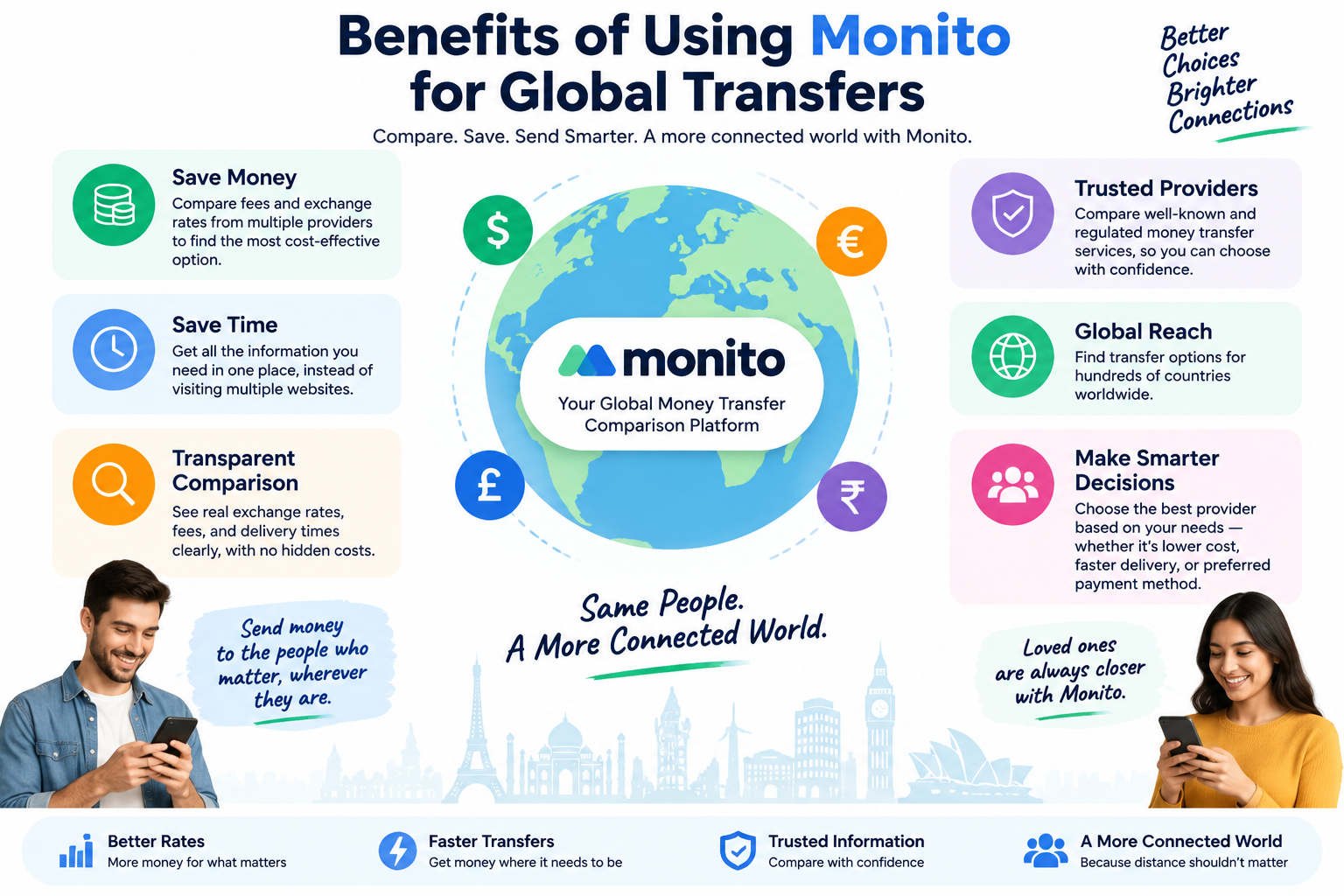
Monito provides several advantages for people who regularly send money internationally.
The biggest benefit is saving time. Instead of researching multiple companies, users can compare options quickly.
Another major advantage is cost awareness. Understanding the complete cost of a transfer helps users avoid unnecessary expenses.
For frequent international payments, these savings can become significant. A better exchange rate on every transaction can add up over months or years.
Is Monito Safe and Reliable?
Monito itself does not hold or transfer user funds. It works as a comparison service that directs users toward external providers.
This means the safety of the actual transaction depends on the provider selected by the user.
Users should always check:
- Provider licensing
- Security practices
- Customer reviews
- Transfer policies
Monito can help with comparison, but users should still make informed decisions before sending large amounts.
Monito vs Traditional Bank Transfers
Feature | Monito Comparison | Traditional Banks |
Cost Comparison | Easy comparison of multiple providers | Usually limited to one bank |
Exchange Rates | Shows different options | May include higher margins |
Convenience | Online comparison | Often requires banking processes |
Provider Choice | Multiple options | Single institution |
Traditional banks remain useful for many customers, especially for large transactions or existing banking relationships. However, comparison platforms can help users discover potentially cheaper alternatives.
Choosing the Right Accounting Support with The Accountancy Partnership
A Complete Guide to Understanding smava Kreditpartnerprogramm DE
Your Guide to Exploring Quinstreet Personal Loans (US) and Financing Options
A Complete Guide to DHgate for Online Shoppers and Businesses
A Complete Guide to BANGGOOD TECHNOLOGY CO., LIMITED and Its Online Marketplace
Tips for Getting the Best International Transfer Rates
To maximize savings when sending money internationally:
- Compare providers before every major transfer.
- Check exchange rates, not just fees.
- Avoid sending money during unfavorable currency movements when possible.
- Use rate alerts if available.
- Confirm recipient details carefully.
- Consider transfer speed and reliability alongside cost.
International transfers are not one-size-fits-all. The best service depends on your specific route, amount, and priorities.
Conclusion
International money transfers no longer need to be confusing or expensive. With multiple providers competing globally, users have more choices than ever before. However, having choices also creates complexity because fees, exchange rates, and delivery options vary significantly.
Monito helps simplify this process by allowing users to compare international transfer services before making decisions. By focusing on total costs rather than just advertised fees, users can make smarter financial choices.
Whether you send money occasionally or manage regular international payments, using a comparison platform can help you save time, understand pricing, and choose a service that matches your needs.
Frequently Asked Questions
Q. What is Monito used for?
A. Monito is used to compare international money transfer services, helping users find providers with suitable fees, exchange rates, and delivery options.
Q. Does Monito send money directly?
A. No. Monito does not process transfers itself. It helps users compare providers and then connects them with the chosen service.
Q. Is Monito free to use?
A. Yes, users can compare transfer options without paying a subscription fee.
Q. Can Monito help reduce transfer costs?
A. Yes. By comparing different providers, users may find better exchange rates and lower overall costs.
Q.Should I compare transfers before every payment?
A. Yes. Exchange rates and provider offers change regularly, so comparing before each significant transfer can help you get better value.
Table of Contents
Related Posts